

Your cart
There are no more items in your cart

Density is a fundamental physical property that relates the mass of a substance to its volume. In the laboratory, accurately knowing the density of a liquid enables its characterization, identification, purity control, or validation of quality processes. One of the most precise and accessible methods for this determination is the use of a pycnometer, a calibrated glass device designed to measure density with high precision.
Despite its simplicity, the pycnometer allows highly reliable results when used correctly and when environmental conditions such as temperature are properly controlled. In this article, we explore in detail how to use a pycnometer to measure and calculate liquid density step by step, including the required materials, standard procedures, and key considerations to ensure reliable data.
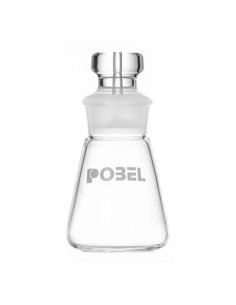
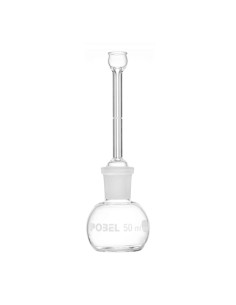
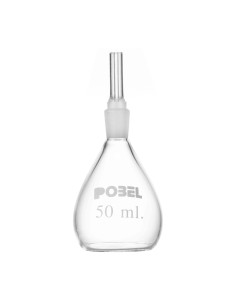
A pycnometer is a small-volume glass flask with a narrow neck, manufactured with high precision and calibrated to contain a specific volume at a defined temperature, usually 20 °C. It typically has a cap or stopper with a capillary tube to release excess liquid when closed, ensuring constant and reproducible volume.
While pycnometers vary in shape and capacity, they all facilitate gravimetric density determination by measuring known mass and volume.
The density (ρ) is defined as:
ρ = m / V
Where:
ρ is the density (g/cm³)
m is the mass of the liquid (g)
V is the volume of the liquid (cm³)
The procedure consists of weighing the empty pycnometer, filling it with the liquid to be measured, weighing it again, and using the known volume to calculate density.
The use of the pycnometer is common in:
Physicochemical analysis laboratories
Quality control of raw materials and finished products
Characterization of organic and inorganic liquids
Purity verification of liquid substances
Comparison with theoretical densities in academic practice
You’ll need the following laboratory equipment:
Calibrated pycnometer (typically 25 ml or 50 ml)
Analytical balance (precision of at least 0.0001 g)
Precision thermometer
Water bath or thermostatic bath
Sample liquid
Gloves or tongs (to avoid heat transfer)
Clean absorbent paper or cloth
Desiccator (optional for moisture control)
Wash the pycnometer with distilled water and neutral detergent if needed.
Rinse multiple times with the sample liquid.
Ensure the pycnometer is dry before proceeding.
Place the clean, dry pycnometer on the analytical balance.
Record the mass as m₀.
Avoid touching it directly to prevent heating.
Fill it with the sample liquid to the calibration line or until it overflows.
Place the stopper and let any excess liquid exit through the capillary.
Dry the exterior of the pycnometer.
Weigh the filled pycnometer and record the mass as m₁.
Ensure the liquid temperature matches the calibration temperature.
Calculate liquid mass:
m = m₁ – m₀
Use the volume indicated by the manufacturer (V)
Apply the formula:
ρ = m / V
Repeat the measurement 3 times for reliability.
If results vary significantly, review the procedure.
Liquid density changes with temperature. If no temperature control system is used, apply a correction factor based on standard density tables for the specific liquid.
Assume:
Empty pycnometer mass: 35.000 g
Filled pycnometer mass: 60.000 g
Volume: 25 ml
Then:
Mass = 60.000 – 35.000 = 25.000 g
Density = 25.000 g / 25 ml = 1.000 g/cm³
This matches the theoretical density of water at 20 °C.
High precision without complex equipment
Low cost and simple setup
Suitable for viscous or immiscible liquids
Useful in quality control and teaching
Ensure temperature matches calibration point
Don’t use damaged or uncalibrated pycnometers
Calibrate the balance periodically
Use gloves to avoid altering temperature during handling
The pycnometer is a simple yet powerful tool for measuring the density of liquids in the laboratory. When used properly, it yields accurate and reproducible results, making it ideal for quality control, material characterization, and educational purposes.

 Quick delivery
 High quality
 Safe payment