


SHORT-STEM FUNNEL
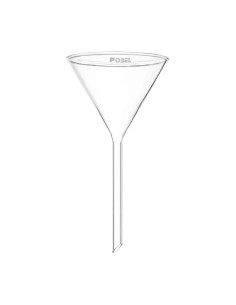
Short-Neck Funnels
In a modern laboratory, space is often a luxury—especially inside a fume hood or within complex setups. Operational efficiency depends not only on the sophistication of the instruments but also on the smart selection of the simplest accessories. In this context, the short-stem funnel (also known as short-neck or short-tube funnel) demonstrates its strategic value.
This type of laboratory funnel, with its conical design ending abruptly in a very short stem, is optimized for situations where height is limited and minimizing the contact surface is critical.
If you work with glass laboratory reactors, you likely face modular setups where every centimeter counts. The short-neck funnel is ideal for adding reagents to small flasks, performing rapid filtration of small volumes, or minimizing the contact of the liquid with air or glass walls. Its design is inherently tied to reducing losses and preventing surface tension issues—factors that make this utensil an indispensable component.
Advantages
The defining feature of the short-stem funnel is the extreme reduction in the length of its discharge tube. This geometric characteristic is not accidental—it solves common problems of handling and purity.
Overcoming Height Restrictions
In the laboratory, many processes must be performed in confined spaces:
-
Fume Hoods: Vertical space inside a fume hood is often limited by supports, lighting, or utilities. The short-stem funnel allows the addition of reagents to tall flasks or the mouth of a glass laboratory reactor without compromising ergonomics or safety. It optimizes available vertical space.
-
Modular Setups: In multistage synthesis systems, where several accessories (thermometers, stirrers, condensers) are connected to the reactor, the short stem facilitates handling and access to addition ports without interfering with other components. It improves accessibility in complex assemblies.
Preventing Retention and Adhesion
One of the greatest challenges in quantitative analysis is sample loss due to liquid adhering to glass walls.
-
Minimized Surface Area: Reducing the stem length directly reduces the glass surface in contact with the liquid during transfer. This minimizes retention losses and improves the accuracy of quantitative liquid transfer.
-
Surface Tension Flow: In a long stem, surface tension can cause the final drop to hang at the tip. The short stem minimizes this effect, ensuring cleaner and faster drainage. This guarantees the transfer of precise volumes.
Key Applications: When Precision Requires a Short Stem
The short-stem funnel is not just a space-saving solution—it is a technical choice for sensitive processes.
Gravimetry and Quantitative Analysis
In gravimetric analysis or the preparation of standard solutions, precision is paramount.
-
Quantitative Transfer: This type of funnel is ideal for transferring solutions or powders into volumetric or calibrated flasks. Its design allows complete rinsing of the stem with solvent, ensuring that 100% of the material is introduced into the flask.
-
Minimized Evaporation: When transferring volatile solvents, the short stem reduces the time the liquid is exposed to air within the funnel, minimizing evaporation losses that could alter concentration.
Rapid Filtration of Small Volumes
When used as a filtration funnel in qualitative analysis or intermediate synthesis steps:
-
Optimized Speed: For small volumes, the short stem allows rapid gravity filtration. The liquid reaches the receiver as quickly as possible, avoiding evaporation and shortening process time.
-
Preparation of Reactor Reagents: When a solvent needs quick filtration before being introduced into a glass laboratory reactor for an air- or impurity-sensitive reaction, the short-neck funnel streamlines this critical step.
Integration into Glass Laboratory Reactor Systems
Setting up a reaction system in a glass laboratory reactor requires careful planning of accessories. The short-stem funnel is used to optimize both loading efficiency and safety.
Addition to Narrow-Neck Containers
-
Adaptation to Volumetric Flasks: Volumetric or round-bottom flasks (commonly used in glass reactor setups) have narrow necks. The compact design of the short-stem funnel fits better, facilitating addition without the need for larger, cumbersome funnels.
-
Splash Reduction: Contrary to what one might think, an excessively long stem can cause splashing if the liquid impacts the existing solution level. The short stem, when used correctly, allows controlled discharge that minimizes turbulence and foaming.
The Element of Safety and Control
Although not a safety funnel per se, the short stem allows excellent visual control:
-
Flow Observation: The operator can easily observe the entire flow until the last drop is released into the glass laboratory reactor. This allows constant monitoring and immediate intervention if any blockage or irregular flow occurs.
Selection Criteria and Rigorous Maintenance
Selecting and caring for a short-stem funnel is part of maintaining analytical precision.
Selection Based on Volume and Height
-
Sample Volume: Choose a funnel size appropriate to the volume you handle. A funnel too large for a small sample increases loss by adhesion.
-
Working Height: Always check the available height in your fume hood or reactor setup. The short stem is the preferred solution when space is limited.
-
Material: As with all critical instruments, it should be made of borosilicate glass 3.3 to guarantee chemical inertness and thermal shock resistance.
Cleaning Practices for Quantitative Purity
Because it is frequently used in quantitative analyses, cleaning a short-stem funnel must be meticulous:
-
Detailed Rinsing: After transfer, both the stem and cone should be repeatedly rinsed with a small stream of solvent to ensure that all traces of reagent are washed into the receiving vessel.
-
Safe Storage: Due to its delicate structure and the risk of stem breakage, it should be stored in racks or drawers where it is not subjected to pressure or contact with heavy instruments. Visual inspection should be routine.
Impact on Repeatability and Scientific Reliability
The function of the short-stem funnel goes beyond simple transfer—it is a key element in metrological reliability. By minimizing material loss and the risk of contamination through air contact, the funnel directly contributes to:
-
Better Repeatability: Variability between reagent additions and measurements is reduced—a fundamental factor in any synthesis or analysis performed with a glass laboratory reactor.
-
Analytical Integrity: By ensuring complete sample transfer, the concentration of reagents is exactly as expected, which is vital for accurate interpretation of experimental data.
In Summary
The short-stem funnel is the ideal accessory for scientists who value quantitative precision, efficiency in confined spaces, and loss minimization in their most demanding protocols.
Pobel short-stem funnels are designed for fast and direct transfers into wide-mouth or low-height containers. Their compact design reduces flow resistance and facilitates pouring of liquids that do not require fine flow control.
Made from high-quality borosilicate glass, they offer excellent thermal and chemical resistance.
Need advice or a personalized quote? Contact us, and we’ll help you choose the funnel best suited to your application.
 Quick delivery
 High quality
 Safe payment