


CONICAL FUNNEL LABORATORY


APPARATUS - SPARE PARTS
SEPARATING FUNNEL FOR TRICHINELLA EQUIPMENT


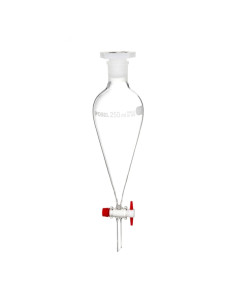


Within the vast world of laboratory equipment, few shapes are as recognizable and essential as the conical laboratory funnel. This borosilicate glass utensil—characterized by its truncated cone shape ending in a cylindrical stem—is the foundation of two of the most fundamental operations in analytical and synthetic chemistry: the clean transfer of reagents and gravity filtration.
Its geometric simplicity hides optimized efficiency: the standard 60-degree angle ensures that the filter paper fits perfectly, preventing side leaks that could compromise the purity of the filtrate.
If you work with glass laboratory reactors, you know that adding a reagent or carrying out subsequent purification are steps with no room for error. The conical funnel is your ally to avoid spills and ensure that the entire material reaches the flask or reaction vessel. In the following text, we will explore in depth the types, uses, and technical considerations of these laboratory funnels, understanding how this elemental tool becomes a critical piece of your laboratory infrastructure.
The Dual Function of the Conical Funnel: Transfer and Filtration
The conical design meets two main needs in the laboratory. Understanding which one you are prioritizing at any given time helps you choose the right variant and the proper handling technique.
Clean Substance Transfer
The most basic function of the conical funnel is the transfer of liquids or granular solids between containers.
-
Avoiding Spills: The wide mouth of the cone serves as an easy target when pouring substances, minimizing the chance of spills—critical when handling expensive or hazardous reagents.
-
Pouring Speed: The design allows the substance to flow quickly by gravity. For viscous liquids or powders, the key lies in the stem diameter—if too narrow, clogs will occur, slowing the process. The stem should be chosen according to the viscosity of the fluid.
The Filtration Funnel Par Excellence
In the lab, when we refer to a filtration funnel, we usually mean the standard conical type. Its design is intrinsically linked to filter paper.
-
Filter Paper Seating: The 60-degree cone angle is designed so that quarter-folded filter paper fits perfectly, creating a (non-hermetic) seal that optimizes filtration surface area.
-
Use with Glass Laboratory Reactors: Although it does not connect directly to the reactor, the conical funnel is often used to filter solvents or starting reagents before they are added to the reaction vessel—ensuring that only pure components enter the synthesis system. This guarantees the purity of initial inputs.
Conical Variations: Adapting the Design to the Task
While the conical shape is constant, variations in stem length and material determine the utility of each funnel. The quality of borosilicate glass is what gives them their durability and strength.
The Importance of the Stem in Transfer
-
Long-Stem Funnel: Ideal for transferring liquids into flasks with narrow necks or deep systems such as glass laboratory reactors. The long stem ensures that the liquid falls below the existing surface, preventing splashing and foaming.
-
Short-Stem Funnel: Used when height is limited or when reducing excessive liquid adhesion to the stem walls is desired. Preferred in gravimetric analysis, where transfer precision is critical.
The Common Confusion: Conical Filtration Funnel vs. Conical Separatory Funnel
It is important to differentiate between a simple conical filtration funnel and a conical separatory funnel. Although both share a conical shape, their functions and control mechanisms are entirely different.
-
Separation Mechanism: The conical separatory funnel uses a stopcock (glass or PTFE) on the stem, allowing the contents to be retained and only the lower phase of two immiscible liquids to be slowly drained.
-
Use: While the simple funnel filters, the separatory funnel separates. It is crucial in purification and chemical extraction, often as a step following synthesis carried out in glass laboratory reactors. Its purpose is liquid phase separation.
Technical Considerations of Borosilicate Glass
When discussing conical laboratory funnels, the material’s resistance and inertness are non-negotiable factors. Borosilicate glass 3.3 is the industry gold standard.
Chemical and Thermal Resistance
The ability of a funnel to withstand concentrated acids, strong bases, or organic solvents without degrading or leaching ions is vital.
-
Process Purity: The chemical inertness of borosilicate ensures no cross-contamination in your samples, maintaining result integrity—even when working with extremely sensitive substances.
-
Use with Heated Reactors: Although conical funnels are not usually heated directly, they often handle hot liquids coming from a boiling flask or a glass reactor. Their thermal shock resistance prevents unexpected and dangerous breakage.
The Conical Funnel in Reaction System Setup
The optimization of an experiment often depends on the correct selection of all its components. In scaled synthesis, the conical funnel integrates into the reactor setup in various ways.
Adding Solid or Viscous Reagents
When introducing a solid or thick liquid into the reaction vessel:
-
Wide-Stem Funnel: A conical funnel with a large-diameter stem is the best choice to ensure that powders or gels flow freely without clogging the mouth of a glass reactor.
-
Wall Cleaning: The conical angle facilitates rinsing or scraping the walls with a small amount of solvent, ensuring that 100% of the initial reagent enters the synthesis system—maximizing material recovery.
Filtration and Product Isolation
After a reaction, the resulting mixture often requires filtration. Although Büchner funnels (for vacuum filtration) are used on a larger scale, the simple conical funnel is ideal for:
-
Rapid Gravity Filtration: When the precipitate is coarse and the solution has low viscosity, the conical filtration funnel with pleated filter paper allows exceptionally fast separation.
-
Sample Preparation: The conical funnel is used to remove coarse particles before introducing the final sample into sensitive analytical instruments, thus protecting delicate equipment.
Handling and Maintenance of Conical Equipment
The longevity and precision of your funnels depend on careful handling and meticulous cleaning.
Best Practices for Cleaning and Storage
-
Immediate Cleaning: Dried residues are difficult to remove. The conical funnel should be cleaned immediately after use, especially if polymers or easily crystallizing substances have been handled.
-
Visual Inspection: Before each use, inspect the funnel—including the stem—for fine cracks or chips that could compromise safety or experiment integrity. Damage to the glass can be catastrophic if the funnel contains a corrosive reagent to be added to a glass reactor under controlled conditions.
The Secret of Gravity Filtration
To achieve maximum efficiency from your conical filtration funnel:
-
Filter Fit: Ensure that the filter paper fits snugly to the cone (60-degree angle). A poorly fitted paper allows liquid to pass through the sides unfiltered.
-
Stem Length: The tip of the stem should touch the inner wall of the receiving flask. This creates a siphon effect that significantly increases filtration speed.
If you’re looking for laboratory equipment, you’ve come to the right place. At Pobel, we have been specialized manufacturers for over 40 years.
Contact us, and we will advise you on our products and your specific needs.
 Quick delivery
 High quality
 Safe payment