


DROPPING AND SEPARATING FUNNELS








In the rigorous environment of chemistry and research, where every milliliter and every gram matter, the transfer and handling of substances require absolute precision. The laboratory funnel, although it may seem like the simplest of instruments, is in fact a critical piece that ensures this precision. Most synthesis, purification, or reagent addition processes involving glass reactors depend on the correct choice of this tool.
If your work involves controlled dosing, phase separation, or rapid filtration, the shape and design of this instrument are determining factors.
It is important to clarify that although people often refer to “crystal laboratory funnels,” the correct technical term refers to borosilicate glass. This material is not crystal, but a special type of glass that resists thermal shock, chemical attack, and ensures the necessary inertness so that the funnel does not contaminate your samples. Choosing the right one not only prevents spills or reagent loss but also optimizes work time, ensuring the integrity of your results from the very first step of handling.
The variety of glass funnels reflects the complexity of laboratory tasks. Each design is optimized for a specific function—transfer, controlled addition, or separation.
Charging funnels are essential in chemical synthesis and systems where the controlled introduction of a liquid must be slow and precise, especially when working with a sophisticated reaction vessel or glass laboratory reactors.
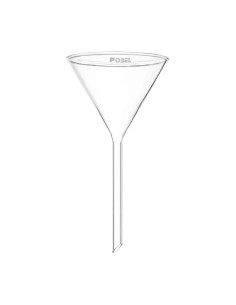
Standard Charging Funnel: Used for general addition of liquids or solutions to a system. Its simple design and narrow stem minimize the reagent’s exposure to air. Ideal for adding moderate volumes.
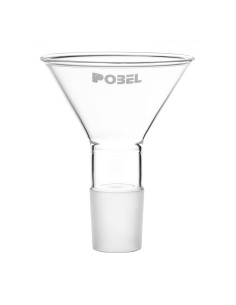
Charging Funnel with Ground Joint: This design is crucial for maintaining system tightness. The ground joint allows the funnel to fit hermetically onto a flask or glass reactor, preventing the loss of volatile vapors or the entry of external moisture. Ensures airtightness of the reaction system.
Graduated Charging Funnel: Incorporates volume markings. Used when it is necessary to measure with some precision the amount of liquid being added to a reaction system. Allows simultaneous dosing and measurement.
Charging Funnel with Pressure Equalization Tube: Essential when adding liquid to a closed (such as a glass reactor) or pressurized system. The side tube equalizes the pressure between the funnel and the system, preventing liquid blockage or interference with internal reactor pressure.
Separatory funnels are the ultimate tool for separating immiscible liquids (such as water and oil), a critical step in purification and chemical extraction.
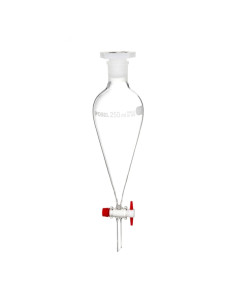
Conical Squibb Separatory Funnel: With its characteristic conical shape, it optimizes visualization of the interface between the two liquids. The control valve (glass or PTFE) allows precise drainage of the lower phase, ensuring maximum visibility for separation.
Graduated Separatory Funnel: Combines separation with volumetric measurement capability, adding precision to the volume of the separated phase.
Choice of Stopcock: The stopcock can be made of glass (greater chemical resistance but requires lubrication) or PTFE (Teflon) (lubrication-free, ideal for working with organic solvents). The choice depends on chemical compatibility and maintenance requirements.
As mentioned earlier, it is common to hear the term “crystal laboratory funnels,” but in professional practice, the material used is borosilicate glass 3.3. This distinction is crucial for both safety and experimental quality.
Borosilicate glass is preferred for manufacturing all critical laboratory instruments—from beakers to complex glass reactors—due to the following technical reasons:
Chemical Resistance: Highly resistant to chemical attack from acids, bases, and organic solvents, ensuring no material leaching into the reagent.
Low Thermal Expansion: Its low coefficient of thermal expansion allows it to withstand sudden temperature changes (thermal shock) without cracking—an essential property in synthesis and heating processes. Prevents catastrophic breakage in the laboratory.
Inertness: Does not react with chemicals, ensuring that sample purity remains uncompromised.
In processes involving gases or vigorous reactions, system and operator safety are top priorities. Safety funnels play a vital role.
These funnels are primarily used to prevent the backflow of liquids or gases in closed systems or for the controlled addition of reagents with a safety margin.
Safety Funnel with Balls: This design incorporates one or two glass spheres that act as rudimentary “valves.” If the pressure inside the glass reactor suddenly drops, the liquid in the funnel is sucked into the system. The balls trap the liquid, preventing the backflow of dangerous gas or reaction product.
Safety Funnel with Ground Joint: Like charging funnels, its ground joint ensures that the device is securely anchored to the system.
Filtration is an art in the laboratory—and the funnel is the main artist. Choosing the correct configuration can mean the difference between a quick separation and a frustrating clog.
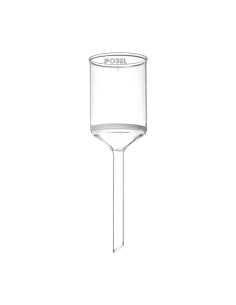
Funnel with Filter Plate: These funnels do not require filter paper. Instead, they feature a porous glass (fritted) plate with a defined porosity grade. Essential in vacuum filtration of fine precipitates, ensuring no contamination from paper fibers.
German-Form Funnel (Hirsch Funnel): Although often associated with vacuum filtration, its smaller design makes it ideal for collecting small amounts of crystals or precipitated solids, optimizing sample recovery.
All laboratory instruments must operate in harmony. The choice of charging and addition accessories is particularly critical when working with complex synthesis equipment. A glass laboratory reactor is a closed system that demands precision in adding every component.
Selecting a wide-stem funnel may be crucial for transferring solid reagents into a reaction vessel without spills, while a separatory funnel becomes an indispensable accessory for in-situ extraction within a modular system. Knowledge of ground-glass joint interfaces allows safe integration of these accessories, ensuring that reactions proceed without external interference and under desired control. The right accessory guarantees system operability.
At Pobel, we manufacture and offer a wide variety of glass laboratory funnels.
Contact us for advice—no obligation—and we will guide you toward the product that best suits your needs.
 Quick delivery
 High quality
 Safe payment


