


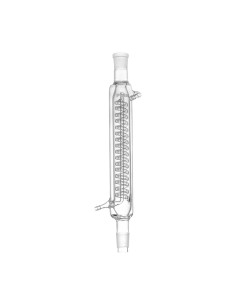
COIL CONDENSERS


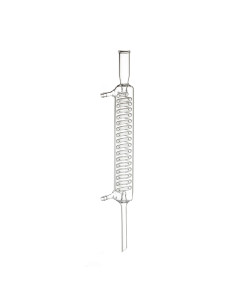

Laboratory coil condensers
In fine chemistry, biochemistry and process engineering, efficient vapour condensation is essential for many laboratory operations. Coil condensers provide a large heat-exchange surface within a relatively compact piece of glassware, making them particularly useful when intensive cooling is required.
Compared with simpler straight condensers, the coiled design increases the available surface for heat transfer between the vapour and the cooling medium. This makes laboratory coil condensers especially suitable for processes such as reflux, distillation, solvent recovery and extraction.
At Pobel, our range of laboratory condensers includes different coil configurations, including Graham and Dimroth condensers manufactured for demanding laboratory applications.
How does a coil condenser work?
The effectiveness of a coil condenser is based on increasing the surface available for heat exchange. Instead of relying exclusively on a straight tube, a helical or coiled section provides a longer thermal exchange path within the condenser.
Increased heat-exchange surface
The coil is the defining feature of this type of laboratory condenser and provides several practical advantages:
- Greater surface area: the helical design provides a larger heat-transfer area than a comparable straight section.
- Efficient heat transfer: the increased surface helps remove heat from vapours more effectively, promoting rapid condensation.
- Compact design: a relatively large cooling surface can be incorporated into a limited overall condenser length.
These characteristics make coil condensers useful when working with volatile substances or processes that generate a significant vapour load.
Types of coil condensers
Not all coiled condensers use exactly the same internal configuration. Two of the best-known laboratory designs are the Graham condenser and the Dimroth condenser.
Graham condenser
A Graham condenser uses a coiled vapour path surrounded by a cooling jacket. The spiral increases the distance travelled by the vapour and provides a large surface through which heat can be transferred to the circulating coolant.
This design can provide efficient condensation in distillation and other laboratory processes where a large cooling surface is beneficial.
Dimroth condenser
In a Dimroth condenser, the arrangement is different. The coolant circulates through an internal cooling circuit, including a helical coil, while the vapour surrounds this cooled surface.
This configuration provides highly effective heat exchange and makes the Dimroth particularly useful for intensive reflux applications and the condensation of volatile solvents.
These condensers are commonly manufactured from borosilicate laboratory glass, a material valued for its chemical resistance and ability to withstand the temperature changes encountered in laboratory processes.
Applications of laboratory coil condensers
The high cooling capacity of coil condensers makes them suitable for applications where efficient vapour recovery and heat transfer are particularly important.
Reflux of volatile solvents
Reflux is one of the most important applications for high-efficiency laboratory condensers. During a reflux reaction, solvent vapour rises from the heated reaction flask, reaches the condenser and is converted back into liquid.
The condensate then returns to the reaction vessel, allowing the mixture to remain at an elevated temperature for an extended period while minimising solvent loss.
This is particularly important when working with volatile solvents, as an efficient reflux condenser helps maintain a stable solvent volume and concentration throughout the reaction.
Distillation processes
Coil condensers can also be integrated into distillation systems where efficient vapour condensation is required. Their large cooling surface helps condense the vapour produced during separation and purification processes.
Efficient condensation is particularly important when vapour production is high or when the compound being recovered is highly volatile. Condensers can form part of larger laboratory distillation installations alongside equipment such as automatic water stills and metallic water stills, depending on the process and application.
Extraction and complex reaction systems
Coil condensers are also used in continuous extraction systems such as Soxhlet apparatus and in more complex reaction assemblies where solvent recovery is required.
Efficient condensation allows the solvent to circulate through the system repeatedly, supporting controlled liquid handling and helping maintain stable operating conditions throughout the process.
Their compatibility with standard laboratory connections also allows them to be incorporated into a wide variety of laboratory glassware and labware assemblies.
How to use a coil condenser correctly
The performance of a laboratory coil condenser depends not only on its design but also on correct installation, coolant circulation and maintenance.
Coolant flow and connections
For water-cooled condensers with an external cooling jacket, coolant is normally introduced through the lower connection and allowed to leave through the upper connection. This helps keep the cooling space filled and provides efficient heat exchange.
All tubing should be securely attached to the condenser connections to minimise the risk of leaks or accidental disconnection during operation.
Collecting the condensed liquid
Once vapour has been condensed, the resulting liquid may need to be collected or measured depending on the procedure.
Calibrated laboratory equipment such as volumetric flasks and graduated cylinders can be used when accurate liquid measurement is required after the condensation or distillation process.
Cleaning and maintenance
Regular cleaning is important for maintaining the performance of coil condensers. Mineral deposits from cooling water and chemical residues from laboratory processes can reduce heat-transfer efficiency or contaminate subsequent procedures.
The appropriate cleaning method will depend on the condenser design, the substances used and the type of residue present. Special care should be taken with internal coils and narrow passages, as these can be more difficult to clean than straight laboratory glassware.
How to choose between Graham, Dimroth and other condensers
The most suitable laboratory condenser depends on the application, vapour load, solvent volatility, required cooling capacity and whether the equipment is being used primarily for reflux or distillation.
Straight condensers such as Liebig models provide a simple solution for many standard distillation procedures. Graham condensers increase the length of the vapour path through their spiral design, while Dimroth condensers provide a large internally cooled surface and are particularly effective for demanding reflux applications.
For this reason, choosing a condenser should be based on the actual requirements of the process rather than simply selecting the design with the greatest cooling capacity.
Coil condensers from Pobel
Pobel supplies coil condensers for laboratory use, including Graham and Dimroth configurations manufactured for efficient vapour condensation in reflux, distillation, extraction and other laboratory processes.
Our range forms part of a broader selection of laboratory condensers and volumetric glassware designed for professional laboratories, research centres, educational facilities and industrial applications.
If you need help choosing between a Graham, Dimroth, Liebig, Allihn or another type of condenser, contact us for technical advice and help selecting the most appropriate equipment for your application.
 Quick delivery
 High quality
 Safe payment