


EXTRACTORS, COMPLETE
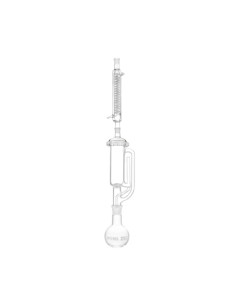

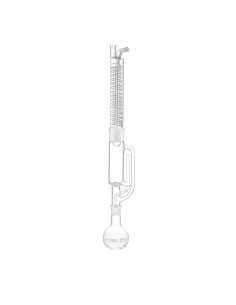
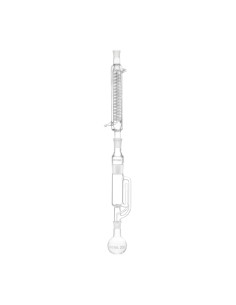

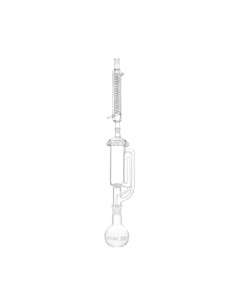
Within the world of analytical chemistry, some tools have stood the test of time thanks to their ingenuity and effectiveness. soxhlet extractors are among the most iconic devices for continuous solid–liquid extraction. Originally designed to quantify lipids in solid samples, this apparatus allows a solvent to be recycled over and over, maximizing process efficiency without the need for constant supervision. Here, the quality of borosilicate glass takes center stage, ensuring that every extraction phase is carried out under the strictest standards of safety and scientific rigor.
The key to this method lies in its closed-loop cycle. Unlike simple maceration or traditional leaching, the solid material is repeatedly exposed to fresh portions of pure solvent.
The process begins when the solvent is heated in a lower flask. Vapors rise through a side arm, condense at the top thanks to a condenser, and drip drop by drop onto the sample. When the central chamber fills, a siphon returns the analyte-loaded liquid to the boiling flask. This mechanism makes it possible to extract compounds with limited solubility in the chosen solvent, achieving near-total recovery of the desired component with minimal resource consumption.
For the process to succeed, it is essential to have a set of parts that fit perfectly together. The tightness of ground-glass joints ensures there are no leaks of flammable or toxic vapors:
Round-bottom flask: where the solvent is placed and the initial heating is applied.
Extractor body: the central piece where the cellulose thimble containing the solid sample is inserted.
Condenser (cooler): essential to convert vapor back into liquid. High-efficiency laboratory condensers largely determine the drip rate.
Heat source: typically a heating mantle that provides precise control of the boiling temperature.
The versatility of this equipment has made it a standard across many sectors. It is not limited to academia; its use is widespread in quality-control workflows:
Food industry: essential to determine fat content in flours, animal feed, and processed products.
Pharma and cosmetics: used to obtain active compounds from medicinal plants or essential oils with high purity.
Environmental analysis: for extracting persistent organic pollutants from soil or sediment samples.
Polymer analysis: useful for removing additives or impurities from plastic materials.
In many of these applications, using extractors certified by Pobel helps ensure results are reproducible and compliant with international testing standards.
A soxhlet extractor does not work in isolation; its performance depends on the precision of other measuring and handling tools. For example, before starting the extraction, the solid sample must be weighed accurately and, in some cases, pre-wetted with precise solvent volumes using manual micropipettes to ensure uniform liquid penetration.
Likewise, once the extraction is complete, technicians often need to transfer the extract into other vessels for subsequent evaporation or analysis. At this stage, using Class A volumetric glassware is essential to avoid introducing errors into final concentration calculations.
Working with systems involving heat and organic vapors requires special attention to risk prevention. The soxhlet extractor must always be firmly anchored to stable supports to avoid vibrations that could loosen joints.
Use fume hoods: always perform these processes under fume extraction to avoid inhaling vapors.
Water flow control: ensure condenser water flow is constant so vapor does not escape into the environment.
Connection pieces: use high-quality glass adapters that can withstand pressure and temperature differences without cracking.
Sample collection: for transferring final liquids, use dispensers that minimize direct contact with the extracted substance.
To extend the service life of these specialized parts, cleaning is a decisive factor. Grease or resin residues can become trapped in the extractor body’s siphon, affecting future analyses.
It is recommended to rinse with clean organic solvents after each use and, in the case of persistent contamination, to use ultrasonic baths. When handling these parts, using glass cylinders to measure cleaning volumes helps maintain strict control over reagent consumption in the laboratory.
Although the classic design remains the most widely used, technology has enabled faster versions. However, for many basic research laboratories, the traditional setup is still the most reliable option due to its low operating cost and proven effectiveness.
Even in advanced glass distillation assemblies, similar principles of recirculation and condensation can be found. The engineering behind a good extraction system is the same that defines a high-quality distillate: purity, thermal control, and structural stability.
The complexity of modern analyses requires a supplier that understands real laboratory needs. At Pobel, we not only provide the highest-quality glassware, but also support researchers in configuring efficient and safe workstations. If you are designing a new extraction protocol or need to renew your borosilicate glass components, our technical team is available to advise you.
Contact us for a personalized quote or technical information about our range of professional products.
 Quick delivery
 High quality
 Safe payment