





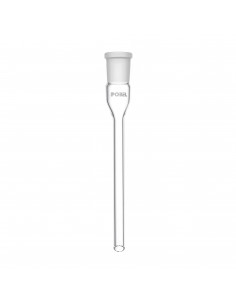
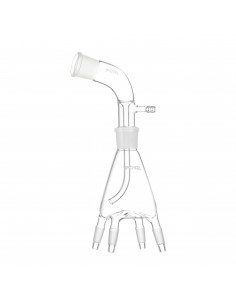
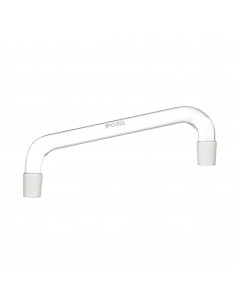
Daily work in a scientific environment demands a level of precision that can only be achieved through the correct interconnection of its components. In this context, laboratory glass adapters act as the essential bridges that allow you to assemble complex setups—from distillation systems to chemical synthesis reactors.
These elements are not mere accessories: they are engineered parts, typically made from borosilicate glass 3.3, that ensure leak-tightness and safety throughout thermal and chemical processes.
The foundation of any modular glass system lies in the ground joint. This matte finish allows two pieces to fit together in a hermetic seal without the need for adhesive sealants that could react with solvents. Glass connectors enable transitions between different joint diameters, commonly referred to as male and female joints.
When setting up a distillation system, you will likely need to connect glass distillation components to receiving flasks of different sizes. At that point, selecting the right adapter determines whether the system will maintain a stable vacuum or suffer pressure losses.
Standardization of these joints under systems such as NS (Normal Schliff) makes it easier for laboratories worldwide to share protocols with confidence that their equipment will be compatible.
Not all processes require the same flow or direction. That is why the variety of shapes is as extensive as the needs of organic and inorganic chemistry:
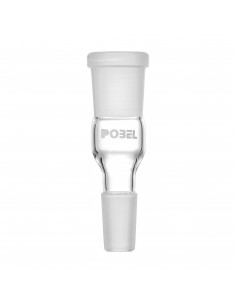
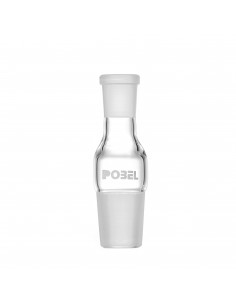
These are the most commonly used to solve compatibility issues. A reducing adapter allows a smaller-joint component to be fitted into a flask with a larger opening. Conversely, expanding adapters perform the opposite function.
It is vital that these transitions are smooth to avoid thermal stresses that could fracture the glass during heating.
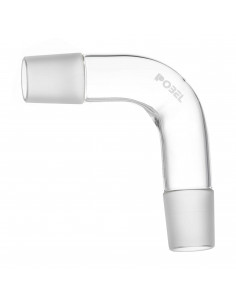
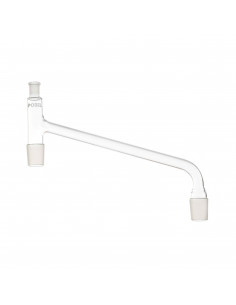
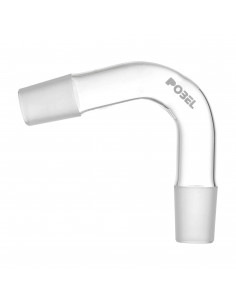
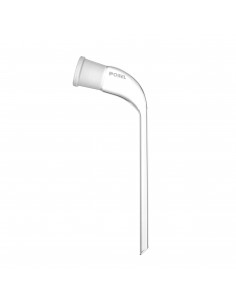
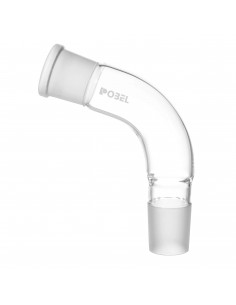
These components direct vapor flow from the boiling flask toward condensers, which are essential for product condensation. They commonly feature 75° or 105° angles, designed to optimize reflux return or distillate takeoff.
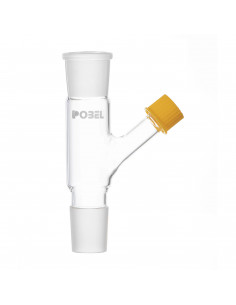
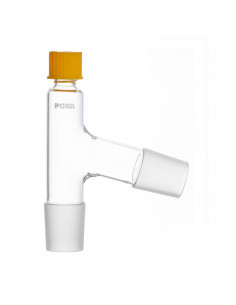
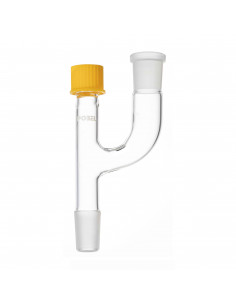
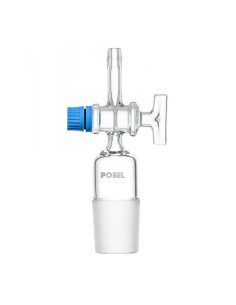
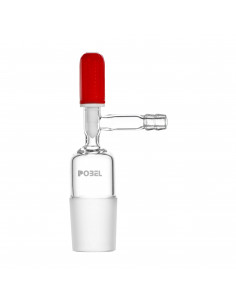
Many processes require constant monitoring of internal temperature. These accessories often include a screw cap or rubber seal that allows a sensor to be inserted without breaking the system’s vacuum.
They are also essential for introducing inert gases such as nitrogen into oxygen-sensitive reactions.
In the lab, nothing works in isolation. Glass adapters coexist with a wide range of instruments intended for precise measurement. In setups requiring controlled reagent addition, it is common to see adapters connected to burettes or separatory funnels.
These parts enable, among other functions:
Connecting vacuum filtration systems to Kitasato flasks.
Coupling fractionating columns to reflux heads.
Facilitating cleaning and liquid transfer into glass cylinders for subsequent volumetric measurement.
Most high-quality connection components are made from borosilicate glass. This material stands out for its low coefficient of thermal expansion, allowing it to withstand sudden temperature changes without breaking—an essential property in environments that combine heating mantles and ice baths.
In addition, its chemical resistance is exceptional. It withstands the action of almost all acids, bases, and organic solvents, with the exception of hydrofluoric acid and concentrated bases at high temperatures. This ensures the adapter does not introduce impurities into the sample.
To extend the service life of your glass parts and prevent the phenomenon known as a “seized joint,” it is advisable to follow a few guidelines:
Light lubrication with silicone grease or vacuum grease, applied only to the upper part of the ground joint.
Immediate cleaning after the experiment, disassembling the parts while they are still warm (if safe to do so).
Visual inspection beforehand to detect microcracks, especially in systems operating under vacuum.
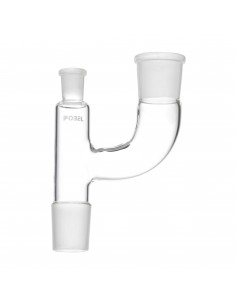
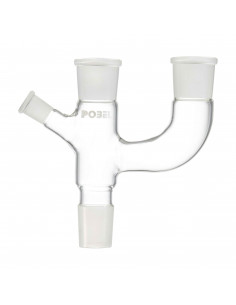
Advances in manufacturing now allow adapters with more efficient, multifunctional geometries. Some parts integrate multiple ports into a single joint, enabling stirring, temperature measurement, and reagent addition simultaneously on one flask.
This optimization is especially useful in small fume hoods or microscale work, where every centimeter matters.
In academic research and the pharmaceutical industry, modularity is key. Adapters make it possible to transform a basic set of flasks and condensers into multiple experimental configurations:
Extraction: connection between soxhlet extractors and round-bottom flasks.
Gas handling: diverting byproducts to cold traps or neutralization systems.
Integration with electronics: introducing digital probes or PTFE tubing from peristaltic pumps.
Never force a connection that does not fit perfectly. A poorly matched joint creates stresses that can lead to breakage under heat, with the associated chemical hazard.
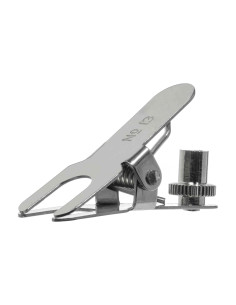
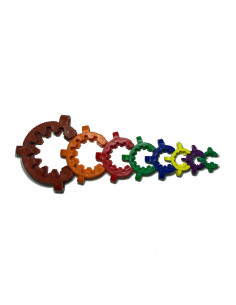
Using safety clips for ground-glass joints is recommended practice, as they keep pieces together during brief overpressure events and help prevent accidental release of hazardous vapors.
Adapters are what give modular glassware its purpose. Without them, the laboratory would be a collection of isolated vessels.
Selecting them correctly—considering joint sizes and the thermal conditions of the process—is essential for safe and efficient scientific practice.
Whether you are assembling a complex reflux system or a simple filtration setup, glass quality and joint finishing are what protect your work.
Choosing the right component can make the difference between a successful process and an unnecessary risk. At Pobel, we have decades of experience manufacturing and distributing high-precision glassware.
If you have questions about joints or configurations, our team can help you make the right choice. Contact us with no obligation—we’ll be happy to assist.
Get in touch to receive detailed information about our catalog and personalized solutions.
 Quick delivery
 High quality
 Safe payment