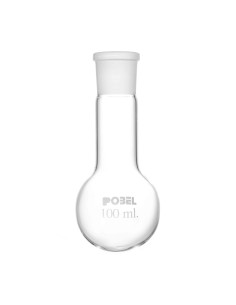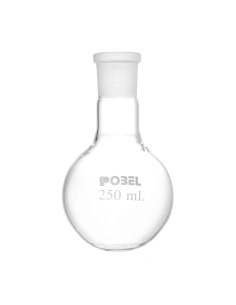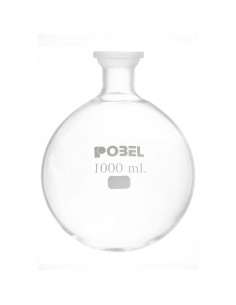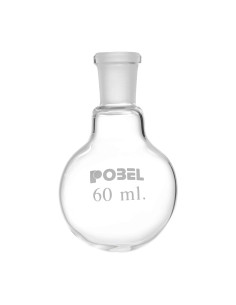


The round-bottom flask is an essential instrument in chemistry, biology, pharmacology, and chemical engineering laboratories. It is characterized by a spherical body and a narrow neck, typically made from heat-resistant borosilicate glass. Its shape serves specific purposes such as controlled heating, mixing, and chemical reaction management.
In this article, we explore its function, types, common uses, and compatible materials, offering a professional guide for students and laboratory professionals alike.
What is a round-bottom flask?
A round-bottom flask is a laboratory vessel with a spherical body and a narrow neck, used to contain substances and carry out processes involving heat or agitation.
Technical characteristics:
-
Made of borosilicate glass, resistant to thermal shock.
-
Straight or ground neck for secure connections.
-
Available in various capacities, from 50 mL to several liters.
-
With either a fully rounded base (requires support) or flat bottom (can stand on surfaces).
Main functions of a round-bottom flask
1. Uniform heating
The spherical shape ensures even heat distribution, making it ideal for sensitive reactions requiring constant temperatures.
2. Chemical reactions
Used for controlled chemical reactions, especially those involving reflux. The narrow neck allows secure placement of stoppers, thermometers, or distillation columns.
3. Distillation and reflux
A standard part of distillation setups (simple or fractional). Acts as the boiling container in conjunction with condensers.
4. Solution preparation
Also used for dissolving reagents under agitation or heat.
Types of round-bottom flasks
Single-neck round-bottom flask
-
One straight or ground neck.
-
Best for basic heating or simple distillations.
Multi-neck round-bottom flask
-
Allows simultaneous connection of multiple elements (thermometer, condenser, etc.).
-
Common in organic synthesis and complex setups.
Flat-bottom round flask
-
Can sit on flat surfaces.
-
Less efficient heat distribution, but more stable.
Fully round-bottom flask
-
Better heat distribution.
-
Requires support such as clamps or heating mantles.
Why is its shape important?
The round shape:
-
Prevents hotspots during heating.
-
Facilitates mixing via agitation or bubbling.
-
Minimizes evaporation loss due to reduced surface area.
Common applications
-
Reflux reactions
-
Organic synthesis
-
Solution preparation
-
Volatile liquid distillation
-
Solvent evaporation using a rotary evaporator
Required materials for use
The round-bottom flask is commonly used alongside accessories for various lab configurations:
-
Condensers (reflux or Liebig)
-
Stoppers or ground glass adapters
-
Metal ring stands or clamps
Best practices
-
Always inspect the flask before heating for cracks or residues.
-
Use indirect heating methods to avoid thermal shock.
-
Never heat empty flasks.
-
For pressurized reactions, use release valves or safety protocols.
Conclusion
The round-bottom flask plays a key role in modern laboratory work. Its optimized design, thermal resistance, and multifunctional capacity make it a vital tool for procedures like distillation, reflux, and solution preparation. Choosing the right model and using proper techniques ensures accurate and safe results.
Related products