


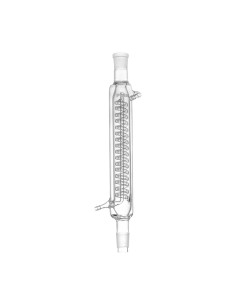
DIMROTH CONDENSERS


Dimroth condensers
In organic chemistry and pharmaceutical synthesis, where efficiency and minimising reagent loss are critical, choosing the right condensation equipment can be a determining factor in experimental success. Dimroth condensers stand out for their highly efficient design, particularly for the reflux of highly volatile solvents.
Unlike straight condensers such as Liebig condensers or even coil condensers such as Graham condensers, the Dimroth design uses an internal cooling coil that is directly exposed to the vapour.
This unique configuration makes these laboratory condensers an excellent choice for processes requiring rapid and intensive condensation within a compact space. Their design is particularly well suited to reflux applications, efficiently converting vapour back into liquid and returning the solvent to the reaction flask with minimal loss.
This not only helps reduce the consumption of costly reagents but also contributes to maintaining a stable concentration of the reaction mixture throughout the process.
How a Dimroth condenser works
The key to the high efficiency of a Dimroth condenser lies in its configuration, a variation of the coil design that prioritises direct contact between the vapour and the cooled surface.
Double-coil structure
A Dimroth condenser is immediately recognisable by the helical cooling coil located along the central axis of the condenser.
- Coolant flow: unlike other condensers in which the cooling fluid surrounds the vapour tube, in a Dimroth condenser water or another coolant circulates through the internal coil. This is often designed as a double coil to further increase the cooling surface exposed directly to the vapour.
- Vapour flow: the vapour rises through the space surrounding the cooling coil. As it comes into contact with the cold surface of the coil, it condenses.
- Condensate return: the condensed liquid runs or drips down the outer surface of the coil and chamber walls before returning to the reaction flask, completing the reflux cycle.
This configuration places the cold surface directly within the vapour stream, maximising heat transfer and therefore increasing the condensation rate.
The principle of maximum heat exchange
The internal coil increases the efficiency of Dimroth condensers for several fundamental reasons:
- Maximum exposure: the vapour comes into close contact with the cooled surface of the central coil, reducing the risk of vapour escaping through the top of the condenser without condensing.
- Compact design: the helical configuration provides a large cooling surface within a relatively compact piece of equipment, making it particularly useful in laboratory setups where space is limited.
- High-performance reflux: the Dimroth design is particularly suitable for reflux operations involving volatile solvents that require intensive condensation.
When to choose a Dimroth condenser
Dimroth condensers are particularly useful in processes where solvent losses need to be minimised or where highly volatile compounds are being handled.
1. Organic synthesis with volatile solvents
In sensitive reactions, maintaining the correct concentration of reagents throughout the heating stage can be essential.
- Maintaining concentration: efficient vapour condensation helps keep the solvent within the system, contributing to stable reaction conditions and helping to achieve the expected reaction yield and product purity.
- Safety: by efficiently condensing vapours, Dimroth condensers also help reduce the release of potentially hazardous or flammable solvent vapours into the laboratory environment.
2. Precise distillation of sensitive components
Although Dimroth condensers are particularly well suited to reflux, they can also be used in demanding distillation applications.
- Small or valuable samples: when working with small quantities or valuable samples, efficient solvent recovery can be particularly important. Accurate collection and subsequent measurement can be carried out using calibrated volumetric glassware.
- Cooling rate: the large cooling surface of the Dimroth design allows vapours to be condensed efficiently, which can help improve the performance of the overall process.
3. Integration into modular reaction systems
Dimroth condensers are also commonly incorporated into more complex reaction vessel systems and distillation setups, including automatic laboratory distillation equipment.
- Compact setups: their high efficiency within a relatively small footprint makes them suitable for systems requiring several process stages or where available laboratory space is limited.
Installation and good practices for Dimroth condensers
To obtain the best performance from a Dimroth condenser, particular attention should be paid to correct installation, coolant circulation and maintenance.
Direction of coolant flow
The direction of coolant circulation is an important consideration when setting up the condenser.
- Counter-current flow: the coolant should enter through the lower connection and leave through the upper connection. This helps maintain effective cooling along the coil and promotes efficient heat exchange between the rising vapour and the cooling fluid.
- Pressure and flow: a constant coolant flow at an appropriate pressure should be maintained. Insufficient flow can reduce condensation efficiency and allow some vapour to escape the system.
Vertical reflux setup
When used for reflux, the Dimroth condenser is installed vertically above the reaction flask so that vapour rises from the flask and the resulting condensate returns by gravity.
- Joints and sealing: a secure connection between the flask and condenser is essential, normally using ground-glass joints. Suitable distilling adapters and accessories help create a stable setup and minimise unwanted vapour losses.
Cleaning considerations
Although its coil design provides excellent condensation performance, it also requires appropriate maintenance.
- Deposit build-up: mineral deposits from cooling water can accumulate inside the coil, while chemical residues may remain on surfaces exposed to the reaction vapours. Regular cleaning with suitable laboratory cleaning solutions helps prevent blockages and maintain efficient heat transfer.
High-performance laboratory condensation equipment from Pobel
Dimroth condensers are an excellent choice for laboratories that require high condensation efficiency in synthesis, reflux and distillation processes. Their internal cooling-coil design makes them particularly suitable for applications involving volatile solvents where efficient vapour recovery is important.
At Pobel, we supply laboratory condensers and volumetric glassware designed for demanding laboratory applications. We understand the importance of reliability in research and laboratory processes and offer equipment suited to a wide range of condensation and liquid-handling requirements.
If you work with highly volatile solvents, want to optimise your reflux processes or need advice on integrating a Dimroth condenser into your laboratory setup, our team can help you choose the most suitable solution.
Contact our team for specialised technical advice and find the right equipment for your laboratory processes.
 Quick delivery
 High quality
 Safe payment