Laboratory filtration equipment
When you work in a scientific environment, you know the purity of your samples is non-negotiable. The separation of solids and liquids is a critical process that defines the success of your subsequent analyses. Therefore, choosing the right laboratory filtration equipment is the first step to ensure reproducible and reliable results.
It doesn’t matter whether you’re clarifying a simple solution or carrying out a complex gravimetric separation: the technical precision of your tools will determine the quality of your final work.
The art of separating with technical precision
Filtration isn’t just passing a liquid through a barrier: it’s a physical process that requires understanding the nature of your mixture. In your day-to-day work, you face different types of particles and viscosities. To handle these variables successfully, you need laboratory filtration supplies that are chemically resistant and structurally robust.
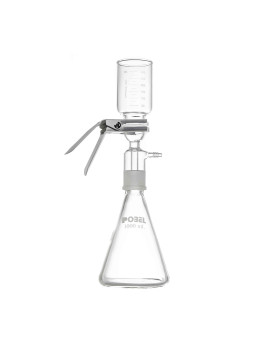
If you’re looking to optimize your time, vacuum filtration is your best ally. By applying a pressure differential, you make the liquid pass through the porous medium much faster than with simple gravity. For this, it’s essential to check your connections and use components designed to withstand negative pressure, such as those you’ll find in our vacuum section.
Essential components for your filtration system
To build an efficient system, you can’t overlook the peripheral elements that ensure tightness and flow. Think of your setup as a set of gears where every piece matters:
-
Specialized funnels: depending on whether you perform conventional filtration or decantation, choosing between different filling and separatory funnels will make a difference in comfort and precision.
-
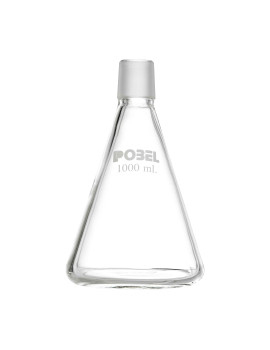
Flasks and containers: the filtrate must be collected in vessels that don’t contaminate the sample. Borosilicate flasks are the gold standard thanks to their neutrality.
-
Supports and adapters: nothing is more frustrating than an unstable setup. Using the correct adapters ensures your system is airtight and safe.
Laboratory filtration equipment and liquid handling
Once you’ve obtained your filtrate, the next challenge is handling it. A perfect filtration is useless if you make precision errors when measuring volume or dispensing the result. This is where the quality of your liquid handling instruments comes into play.
For tasks requiring extreme rigor in volume transfer, I recommend using micropipettes. If your working volume is high, multichannel micropipettes allow you to process multiple samples in seconds while maintaining the integrity you achieved during filtration. By contrast, for more traditional work where visual control is key, graduated pipettes remain essential on any laboratory shelf.
How to choose the right filtration method
Your choice should be based on the final objective of your experiment. Do you need to recover the solid, or are you interested in the clarified liquid?
-
Gravity filtration: the gentlest method. It’s used when the solid is the desired product and you don’t want it to compact too much. For this, high- or low-form laboratory glass beakers are perfect for receiving the flow.
-
Vacuum filtration: ideal for fine particles or viscous solutions. You save time and obtain a much drier solid.
-
Membrane filtration: indispensable when working with small volumes or biological samples that require sterilization.
If your process also requires additional chemical purification after filtration, you may need to consider thermal separation methods using distillation units, or—if you work with specific solvents—the use of extractors to isolate components with maximum purity.
Volumetric precision after filtration
When your sample is already free of impurities thanks to your laboratory filtration equipment, the moment of truth arrives: measurement. Accuracy at this step defines the concentration of your reagents.
To prepare standard solutions, you should always rely on volumetric glassware. Volumetric flasks offer the lowest possible uncertainty. If you need to perform chemical titrations to verify the purity of what you’ve just filtered, burettes with reservoirs will greatly simplify your work, allowing you to work quickly and safely.
Maintenance and protection of your equipment
The durability of your instruments depends on how you care for them after each separation process. Filtration residues can be corrosive or sticky. Therefore, immediate cleaning of your bottles and vials is vital. In addition, if your filtered samples are hygroscopic, don’t forget to protect them from ambient moisture by using desiccators with the appropriate drying agent.
Remember that every detail matters: from choosing the stoppers and joints that maintain vacuum integrity, to using Class A glass graduated cylinders to verify your final volumes. Science is precision, and precision starts at your lab bench.
Find the ideal filtration equipment for your laboratory
We know every laboratory is different and your needs may be very specific. Whether you need to renew your filtration systems or expand your measuring capacity with new variable-volume micropipettes, at Pobel we’re ready to support you.
Your scientific excellence deserves tools that are up to the task. Don’t take chances with materials that don’t guarantee the required airtightness or chemical resistance. Investing in quality ultimately means investing in the truthfulness of your own discoveries.
If you need help configuring your laboratory filtration equipment or would like a personalized quote to equip your center with the best in technical glass and plastic technology, don’t hesitate to write to us. We’re here to help your laboratory run like Swiss clockwork.
Click here and contact Pobel’s expert team to receive technical advice.




 Quick delivery
 High quality
 Safe payment