


PLASTIC LABORATORY BOTTLES
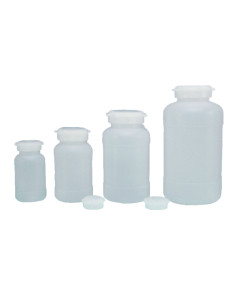
PLASTIC LABORATORY BOTTLES
FLASKS WITH SCREW CAP, WIDE MOUTH

PLASTIC LABORATORY BOTTLES
RESERVOIR BOTTLE WITH PIERCED CAP, FROM PP
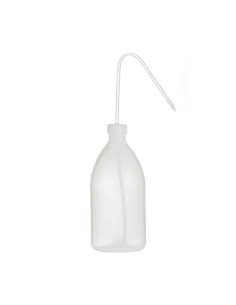
PLASTIC LABORATORY BOTTLES
WASH BOTTLES
Plastic laboratory bottles
Although glassware is traditionally associated with laboratory work, plastic laboratory bottles have become essential for many storage, sampling and liquid handling applications. Their low weight, resistance to breakage and versatility make them a practical alternative to glass in laboratories where durability and ease of handling are important.
Depending on the polymer used, plastic bottles can provide good chemical resistance and are suitable for storing and handling a wide variety of solutions, samples and reagents. Choosing the right material is essential to maintain the integrity of the contents and ensure safe laboratory procedures.
Common materials used in plastic laboratory bottles
The properties of a laboratory plastic bottle depend largely on the polymer from which it is manufactured. Different plastics offer different levels of flexibility, chemical resistance and temperature resistance.
High-density polyethylene (HDPE)
HDPE laboratory bottles are rigid, lightweight and resistant to many acids, bases and aqueous solutions. High-density polyethylene is widely used for general laboratory storage and is particularly suitable when transparency is not essential.
HDPE also provides good impact resistance, making it a practical alternative to glass for routine laboratory applications.
Low-density polyethylene (LDPE)
LDPE laboratory bottles are more flexible than HDPE bottles. This flexibility makes low-density polyethylene particularly suitable for squeeze bottles, wash bottles and other applications where the container needs to be easily compressed.
LDPE also offers resistance to many common laboratory chemicals, although compatibility should always be checked for the specific substance being stored.
Polypropylene (PP)
Polypropylene laboratory bottles combine good chemical resistance with greater temperature resistance than many polyethylene products. Depending on the specification of the bottle, polypropylene can also be suitable for applications requiring sterilisation at elevated temperatures.
Selecting the correct polymer is fundamental to maintaining sample integrity and laboratory safety. An unsuitable plastic may interact with the stored substance or fail under the required working conditions. For controlled reagent transfer and dispensing, suitable liquid handling equipment should also be used.
When should you choose a plastic laboratory bottle?
Glass remains the preferred material for many laboratory applications, but plastic lab bottles offer several advantages that make them particularly useful in certain working environments.
- Resistance to breakage: plastic bottles are much less likely to break if dropped, reducing the risk of spills, sample loss and injuries caused by broken glass.
- Low weight: they are lighter than equivalent glass containers, making them easier to handle and transport, particularly when working with larger volumes.
- Chemical resistance: polymers such as HDPE, LDPE and PP offer good resistance to many laboratory chemicals. The appropriate material should always be selected according to the substance being stored.
- Practicality: their durability and low weight make plastic bottles especially useful for routine laboratory work, sampling, transport and applications where glass breakage would present a problem.
Plastic does, however, have limitations. Depending on the polymer, plastic bottles may be more permeable to gases than glass and may not be suitable for certain organic solvents or other aggressive chemicals. Chemical compatibility should therefore be checked before use.
Common uses of plastic bottles in the laboratory
Plastic laboratory bottles can be used for a wide range of routine laboratory applications.
Storage of reagents and solutions
Plastic bottles are commonly used to store distilled water, saline solutions, buffers and other laboratory reagents that are chemically compatible with the polymer.
The choice between HDPE, LDPE and polypropylene should be based on the chemical properties of the contents and the storage conditions required.
Sample collection and transport
Their resistance to impact and low weight make plastic bottles particularly useful for collecting and transporting samples such as water, soil extracts and other materials used in environmental, industrial and quality-control laboratories.
Reducing the risk of breakage can be particularly important when samples have to be transported outside the laboratory.
Preparation and handling of solutions
Plastic bottles can also be incorporated into workflows involving the preparation, temporary storage and transfer of laboratory solutions.
Equipment such as plastic cylinders and plastic laboratory beakers provides complementary solutions for measuring, mixing and transferring liquids where the use of plastic is preferable to glass.
For applications requiring greater volumetric accuracy, calibrated equipment such as volumetric flasks should be used instead of relying on storage bottles or beakers for measurement.
Wide-mouth and narrow-mouth plastic bottles
The shape of the bottle opening is another important factor when selecting a plastic bottle for laboratory use.
Narrow-mouth bottles
Narrow-mouth bottles provide greater control when pouring liquids and can help reduce the risk of spills. Flexible LDPE versions are particularly useful for applications where the bottle needs to be squeezed or where controlled liquid delivery is required.
Wide-mouth bottles
Wide-mouth bottles provide easier access to the contents and are convenient for filling, emptying and cleaning. Their wider opening can also make them more suitable for powders, solids, viscous materials and applications where instruments need to be inserted into the container.
The appropriate neck design should therefore be selected according to the material being stored and how the bottle will be filled, accessed and emptied.
Plastic wash bottles
Plastic wash bottles are a specific type of flexible laboratory bottle designed to dispense liquids through a narrow outlet tube. They are commonly used for rinsing laboratory glassware, applying distilled water or other compatible washing solutions and directing a controlled stream of liquid onto a specific area.
Polyethylene is particularly suitable for this type of bottle because its flexibility allows the user to generate liquid flow by applying pressure to the body of the container.
Using bottle-top dispensers with laboratory bottles
When reagents need to be dispensed repeatedly and in controlled quantities, a bottle can be combined with a suitable laboratory dispenser.
Bottle-top dispensers can be fitted directly onto compatible reagent bottles, allowing liquid to be dispensed without repeatedly pouring from the container. This can improve control, reduce unnecessary transfers and make repetitive laboratory procedures more efficient.
Before attaching a dispenser, both the bottle material and the dispenser components should be checked for chemical compatibility with the reagent being used.
How to choose a plastic laboratory bottle
Before selecting a plastic bottle, consider the following factors:
- the chemical compatibility between the polymer and the substance being stored;
- whether HDPE, LDPE or polypropylene is most suitable for the application;
- the required bottle capacity;
- whether a rigid or flexible container is preferable;
- whether a wide or narrow mouth is required;
- the type of cap or closure;
- the working and storage temperature;
- and whether the bottle will be used for storage, sampling, transport or dispensing.
The correct combination of material, bottle design and closure helps protect the contents while making routine laboratory handling safer and more efficient.
Plastic laboratory bottles from Pobel
Pobel offers plastic laboratory bottles for different storage and liquid handling applications, including narrow-mouth LDPE bottles, wide-mouth polyethylene bottles, polypropylene bottles and laboratory wash bottles.
The most suitable option will depend on the substance being handled, the required capacity, the chemical resistance of the polymer and the way in which the bottle will be used.
If you need help selecting the most appropriate plastic bottle for your application, contact us for technical advice.
 Quick delivery
 High quality
 Safe payment