


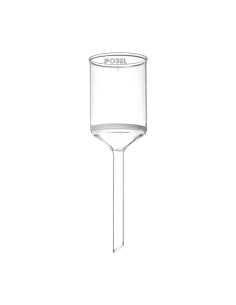
In purification and quantitative analysis processes, filtration is a critical step. While the conical funnel and filter paper perform well in many cases, there is an inherent limitation: potential contamination from paper fibers and the slowness of gravity filtration. This is where the filter plate funnel emerges as an advanced engineering solution.
This utensil, made of borosilicate glass, incorporates a porous sintered glass plate (frit) at its base, eliminating the need for disposable filter media.
Its main advantages lie in speed and purity. Designed to operate under suction (vacuum filtration), this type of laboratory funnel drastically accelerates the separation of a solid or precipitate from a liquid. When working with glass laboratory reactors, fast and contamination-free purification is essential for achieving a final product of high quality and yield. Understanding the different grades of porosity and their specific applications is key to optimizing any isolation or analysis protocol.
The defining feature of these funnels is the porous glass plate, also known as a frit. It is created by heating glass particles until they partially fuse, forming a matrix with highly controlled, interconnected pores.
Analytical Purity: By eliminating filter paper, any risk of contamination from fibers or organic extractables is removed. This is crucial in trace analysis or pharmaceutical product preparation, ensuring unmatched filtrate purity.
Chemical and Thermal Resistance: Because the plate is made of borosilicate glass, it shares the same chemical inertness and thermal shock resistance as other high-quality glassware. It can be used with hot acids and bases without degrading—something filter paper cannot withstand.
Filtration Speed: Filter plate funnels are designed for vacuum-assisted filtration, reducing the isolation time of precipitates from hours to minutes, greatly increasing laboratory efficiency.
The performance of a laboratory filter plate funnel depends on the pore size of the plate, classified by codes (generally from 0 to 5 or 0 to 7, depending on the manufacturer):
Coarse Porosity (e.g., P40/P100): Used for very fast filtration of coarse precipitates or gas diffusion. Ideal for preliminary separations.
Medium Porosity (e.g., P10/P16): The most common range, effective for most medium-sized crystalline precipitates.
Fine Porosity (e.g., P1.6/P4): Used to retain very fine precipitates or microorganisms. The flow rate is slower, but particle retention is maximum—ensuring submicron particle retention.
Different designs integrate the filter plate, each with a specific application in post-reaction purification.
Although the classic Büchner funnel is made of porcelain, the glass version with a filter plate is the standard in analytical and synthetic chemistry due to its visibility and resistance.
Function: Used on top of a Kitasato flask (a flask with a side vacuum outlet) for suction filtration. The vacuum accelerates the rate at which liquid passes through the porous plate.
Use with Glass Laboratory Reactors: After synthesis in a glass reactor, the reaction mixture is transferred to this funnel to isolate the solid product (precipitate). It is the final step before drying and characterization, maximizing product isolation efficiency.
This is a more specialized design that integrates directly into modular systems.
Hermetic Integration: With a ground-glass joint, this funnel can be directly attached to the mouth of a receiving vessel or the port of a closed system. This is vital for filtering air- or moisture-sensitive products, such as those produced in glass laboratory reactors under inert atmosphere, ensuring filtration tightness.
Retention Function: It can also be used in reverse—to filter gas entering the glass reactor, ensuring that only pure gas passes into the reaction system.
The filter plate funnel is an essential tool for post-reaction synthesis operations performed in glass laboratory reactors.
In instrumental analysis, the sample must be perfectly clean to protect sensitive equipment components.
Instrument Protection: Before injection into chromatographs (HPLC or GC) or spectrometers, filtration through a fine-porosity filter plate funnel removes microparticles that could damage columns or injectors—ensuring instrument longevity.
Standardization: Using a filter plate eliminates variability associated with filter paper (different brands, porosities, or folding errors), standardizing the analytical purification step.
When working with hygroscopic compounds or substances that decompose in the presence of air, vacuum filtration in a closed system assisted by this funnel is mandatory.
Controlled Atmosphere: The filter plate funnel can be set up inside a glove box or connected to an inert port, allowing filtration without exposing the product to oxygen. This ensures the stability of reactive compounds.
The main disadvantage of the filter plate is that it is more difficult to clean than paper filters. Proper handling is essential for its durability.
Immediate Cleaning: Cleaning must be performed immediately after filtration. If the precipitate dries on the porous plate, it becomes extremely difficult to remove.
Backwashing: The most effective technique is backwashing—reversing the suction flow and using the most suitable solvent to dissolve residues, forcing it through the plate in the opposite direction to filtration. This prevents permanent pore blockage.
Use of Acids or Bases: For organic residues, organic solvents can be used. For inorganic residues, acidic (e.g., aqua regia) or basic (e.g., alcoholic KOH) cleaning solutions are common. The cleaning agent must be compatible with borosilicate glass.
Porosity Check: If you notice a significant decrease in filtration speed under the same vacuum conditions, the plate is likely partially clogged. A deep cleaning should be performed before using the funnel again in your glass laboratory reactor.
Avoid Scraping: Never attempt to scrape or pick the porous plate with metal or hard objects. This can permanently damage the porous structure, alter the porosity grade, and render the funnel useless for precision work.
Using laboratory filter plate funnels not only enhances purity but also contributes positively to laboratory sustainability.
Waste Reduction: By eliminating the need for filter paper, the amount of contaminated solid waste generated per experiment is reduced.
Process Standardization: Offering a constant, certified porosity grade, the funnel ensures greater repeatability in product isolation—a key factor in validating methodologies that use glass laboratory reactors for synthesizing new compounds.
The Pobel filter plate funnel combines in a single piece a classic funnel and an integrated filtration system, allowing solids and liquids to be separated without additional filter paper. Its sintered glass porous plate ensures uniform filtration and resistance to solvents and high temperatures.
Ideal for chemical, pharmaceutical, or industrial laboratories seeking precision, cleanliness, and efficiency in their filtration processes.
Would you like more information about porosity grades or available sizes? Contact us, and we’ll advise you according to your specific needs.
 Quick delivery
 High quality
 Safe payment