


Your cart
There are no more items in your cart
FUNNELS
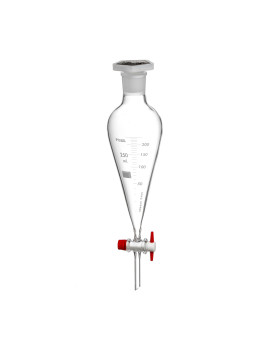
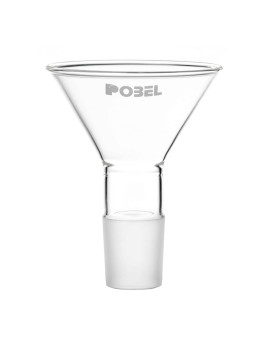


Laboratory Funnels
At the heart of experimental science, where precision in the transfer and filtration of liquids is as crucial as the reaction itself, there exists a piece of equipment as simple as it is indispensable: the laboratory funnel. Often overshadowed by more complex instruments, this tool plays a vital role in chemistry, biology, and materials research.
If you’ve ever worked in a lab, you know that pouring a reagent without spills, or effectively separating a solid from a liquid, directly depends on choosing the right type of funnel. From the most basic conical funnel to sophisticated devices with filter plates, the variety is vast. Understanding their shapes, materials, and specific applications is not just a matter of good practice; it is the foundation for ensuring the integrity of results in any process. Whether handling sensitive samples for a doctoral thesis or performing routine analyses, this instrument ensures that every drop reaches its destination and every filtration is carried out optimally and cleanly.
Types and Uses of Laboratory Funnels
This seemingly simple transfer tool hides a wide range of designs, each optimized for a specific function. Choosing the right one directly affects the speed and purity of your process.
Variety of Glass Funnels for Laboratories
The most common and preferred material is borosilicate glass due to its chemical and thermal resistance. Glass laboratory funnels are transparent, allowing you to observe the flow, and they do not contaminate substances.
-
Standard Conical Funnel: The most recognizable shape, ideal for quickly transferring liquids or granular solids from one container to another. Its 60-degree angle is designed to support conical filter paper, making it perfect for rapid liquid filtrations. Its main use is the fast transfer of substances.
-
Wide-Stem Funnel: Characterized by a wider lower tube, making it ideal for pouring very viscous liquids or transferring powders and solids that could clog a narrow stem. It prevents blockages when handling dense materials.
-
Short-Stem Funnel: Used when height is limited or when liquid must fall quickly without surface tension causing retention. Reduces contamination by preventing splashing.
Specialized Funnels: When Filtration is the Goal
Not all funnels are designed for simple transfers. Many perform the crucial function of filtration or controlled separation.
-
Funnel with Filter Plate (Büchner Funnel): A device that does not use filter paper but instead incorporates a porous sintered glass plate. It is used for vacuum or suction filtration, ideal for isolating fine or crystallized solids from the solvent. It speeds up the separation of precipitates.
-
Cylindrical Funnel with Stopcock: Also known as an addition or separatory funnel. Its cylindrical or pear-shaped body allows separation of immiscible liquids thanks to the stopcock. This control valve enables extremely slow dosing of one reagent into another, which is vital for reactions requiring dropwise addition.
-
Cylindrical Funnel: A variation of the addition funnel, often with a straighter shape that facilitates precise measurement or controlled addition of a liquid to a system, such as a glass reactor, where dosing is crucial to prevent side reactions. Ensures controlled addition in closed systems.
The Role of Funnels in Working with Glass Reactors
The function of the funnel becomes especially critical when working in more complex setups, such as glass laboratory reactors, where tightness and precision in reagent addition determine the success of a chemical synthesis.
Integration in Modular Synthesis Systems
Glass laboratory reactors are essential pieces of equipment that allow scientists to precisely control temperature, pressure, and reagent mixing. Connecting an addition or cylindrical funnel to the top port of a reaction vessel is a common practice.
-
Slow and Controlled Addition: In many organic reactions, it is crucial to add a reagent slowly to maintain temperature or avoid forming undesirable byproducts. Using funnels with a stopcock ensures dropwise addition, essential for keeping reaction kinetics within desired parameters.
-
Isolation and Collection: After synthesis, the contents of the reaction vessel often need to be filtered. The funnel with a filter plate becomes the perfect ally to separate the final solid product from the residual liquid, especially when working with large volumes or fine crystals.
-
Stability and Safety: When transferring large quantities of volatile or hazardous solvents into a glass reactor, the traditional conical funnel helps minimize exposure and ensures that the liquid flows directly into the reaction vessel without splashing. Operator safety and reagent purity are priorities.
Key Criteria for Selecting the Perfect Funnel
Technical and Design Considerations
-
Type of Process: Do you need to transfer a liquid quickly or perform a gradual, controlled addition? Define the function before choosing the tool.
-
Viscosity and Particles: If the liquid is very viscous or contains large particles, a wide-stem funnel will prevent clogs. For clean liquids that need to be poured with minimal splashing into glass reactors, a short-stem funnel is more suitable.
-
Material: Although borosilicate glass is the standard due to its chemical inertness and heat resistance, in certain applications (such as vacuum filtration) porcelain or plastic funnels can be used. However, for precise work and compatibility with most reagents, glass is the ideal material.
Maintenance and Durability
A high-quality glass funnel can last for years with proper care.
-
Immediate Cleaning: Clean immediately after use to prevent crystallization or drying of reagents, which could damage the glass surface.
-
Regular Inspection: Check periodically, especially those with thin stems or stopcocks, for cracks or chips. A defect in the glass could compromise operational safety and experimental accuracy.
The Importance of Purity and Safety in Funnels
In research, every step—no matter how simple—impacts the reliability of results. The funnel is no exception.
Ensuring Analytical Purity
The way reagents are transferred into glass reactors or flasks is critical to avoid cross-contamination. A properly cleaned and sized funnel ensures that no residues remain on its walls that could alter sample concentration or subsequent reactions. Proper use helps:
-
Prevent Sample Loss: The cone and stem design minimizes losses from splashing or adhesion to the walls.
-
Prevent Contamination: Using the right funnel reduces the reagent’s exposure time to air, preventing moisture or CO₂ absorption.
The Crucial Role of Controlled Filtration
When using a funnel with a filter plate or a conical funnel with filter paper, full control over the filtration process is achieved. The ability to precisely separate solid and liquid components is fundamental for isolating and purifying synthesized chemical products in a glass laboratory reactor.
-
Fast Isolation: Filtration funnels enable quick and efficient collection of solids, vital in high-throughput laboratories.
-
Porosity Grades: For those with a filter plate, choosing the appropriate porosity (fine, medium, or coarse) allows adaptation to the particle size of the solid to be retained, optimizing filtrate purity.
Laboratory Funnels at Pobel
If you need this type of instrument—or any other for your laboratory—contact us without obligation. We will advise you on our products and help you find the one that best suits your needs.
 Quick delivery
 High quality
 Safe payment