






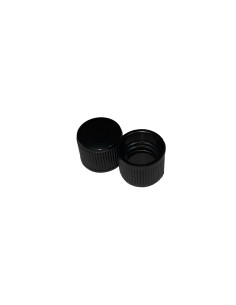

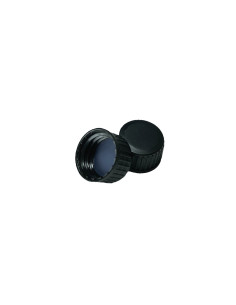

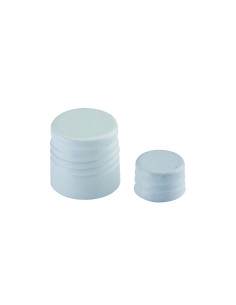


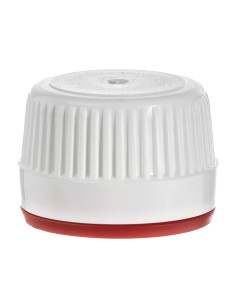


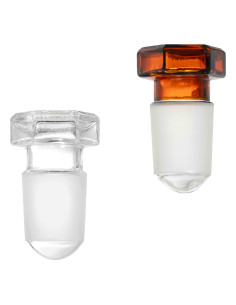
In the daily work of any research center, the integrity of your assays depends on how airtight your setups are. Laboratory stoppers and seals form that critical barrier that prevents sample contamination and ensures chemical reactions occur in a controlled environment.
Whether you’re carrying out a complex distillation or simply storing sensitive reagents, choosing the right closure material is what separates a successful experiment from an accidental product loss—or an incorrect reading due to evaporation. By understanding the properties of each type of closure, you optimize workplace safety and the reliability of your scientific results.
You’ve surely faced the challenge of maintaining an inert atmosphere or a specific pressure level. To make this possible, you need components that fit perfectly onto the openings of your equipment. High-quality stoppers and seals ensure there are no capillary leaks—especially when working with vacuum systems, where any external air intake would ruin the process.
Beyond tightness, these elements also act as chemical and mechanical buffers. A poorly fitted closure on a general-use container can cause dangerous spills. That’s why it’s vital to choose the material—whether rubber, silicone, or PTFE—based on compatibility with the solvents and temperatures you’ll be working with at the bench.
Depending on the equipment you use, your sealing needs will vary considerably:
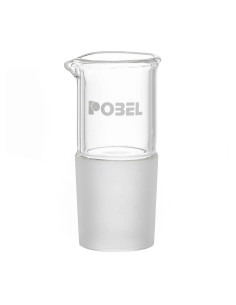
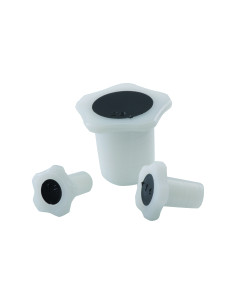
Ground-glass stoppers: preferred for standardized joints, ensuring total chemical neutrality when handling pure reagents in flasks.
Silicone septa: ideal for processes where you need to inject or withdraw substances with needles without breaking the container’s internal atmosphere.
Conical and spherical joints: offer great flexibility in column setups and distillation systems, making alignment of parts easier.
Rubber stoppers: the classic, versatile solution for sealing test tubes and containers that don’t require extreme chemical resistance.
Once you’ve secured your sample with the right laboratory stoppers and seals, it’s time for quantification. Precision in the laboratory doesn’t stop at sealing—it extends to how you measure contents. To prepare standard solutions rigorously, using volumetric flasks is essential; they are designed to work with specific stoppers that prevent volume loss due to volatility.
If your work requires exact liquid transfer, manual micropipettes or variable-volume micropipettes are your best allies. In these cases, ensuring that source and destination containers are properly capped when not in use is fundamental to maintaining the exact concentration of your analytes.
In thermal purification setups, the importance of closures increases dramatically. When operating glass distillation units—or even automatic distillation systems—any crack or poor seal between the evaporation flask and the condensers will result in reduced yield.
Joints must always be clean and, in the case of glass joints, it’s advisable to use a minimal amount of vacuum grease to ensure proper coupling. If your process involves capturing volatiles, gas collectors should be integrated using adapters that ensure the flow is directed exclusively where you want it.
To avoid compromising your safety or your samples, you should follow a risk-based selection logic:
Thermal resistance: if you’ll be heating a sample in laboratory glass beakers that require a lid, make sure the material can withstand the temperature range without deforming.
Chemical inertness: for strong acids or concentrated bases, PTFE (Teflon) is almost always the safest option.
Elasticity: in setups subject to vibrations or slight movements, a rubber or silicone seal will absorb mechanical stress better than a rigid glass-to-glass connection.
If you ever have doubts about which configuration is most suitable for your reactors or nitrogen and vacuum systems, you can always seek expert advice. At Pobel, we’re ready to help you through our Contact Us section.
Long-term storage is where laboratory stoppers and seals truly prove their value. When you store samples in bottles and vials, a faulty seal can cause salt crystallization or hydration of anhydrous compounds.
Even in chemical titration tasks, where you use burettes with reservoirs, the reservoir stopper protects the reagent from carbonation due to contact with air. Every detail matters—from choosing Class A glass graduated cylinders for measurement to the final seal that prevents reagents from degrading before their next use.
At Pobel, we understand that your passion for science requires tools that won’t fail at the most critical moment. We don’t just supply the highest-precision volumetric glassware—we care about every component of your system, including the small closure elements that keep everything under control.
Whether you need to renew your laboratory filtration accessories or you’re setting up a new extractor system, our priority is your success and safety. We know you’re looking for efficiency and error-free results, and that starts with a perfect seal.
Do you need technical advice to choose the most resistant closures for your reagents, or would you like a personalized quote to equip your lab with the best in glassware and accessories?
 Quick delivery
 High quality
 Safe payment