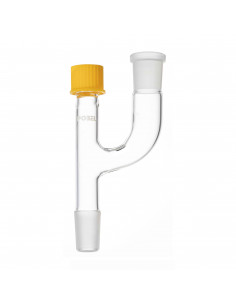
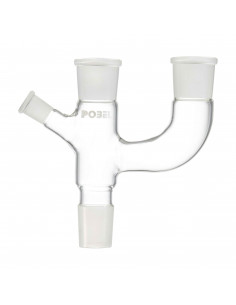
In the routine of an organic chemistry laboratory, configuring a distillation or reaction system is not a task to be taken lightly. The efficiency of a chemical process depends largely on the ability to manage multiple variables simultaneously, and it is here that Claisen llaboratory adapters demonstrate their strategic value. These glass components, with their characteristic bifurcated shape, allow the researcher to add an additional neck to a single-neck flask, facilitating the insertion of thermometers, addition funnels, or fractionating columns without compromising system tightness.
This type of instrumentation is essential when working with substances that require close temperature monitoring or when reagents must be introduced in a controlled manner while the system is under reflux. By providing a parallel path for vapors and a separate path for instrumentation, the risk of liquid projection is avoided and operational safety for the analyst is improved. Below, we break down the technical characteristics that make these components an indispensable tool in any serious research facility.
Anatomy and design of the double-neck connection
The engineering behind this glass accessory responds to a logical need: maximizing the available space in a closed assembly. Its structure consists of a male ground-glass joint at the base and two upper female joints, one positioned directly on the vertical axis and the other offset laterally.
Functionality of the parallel neck
The main vertical arm is typically used for vapor outlet or condenser connection. The lateral neck, in turn, is the ideal location for placing a precision thermometer, as it allows the sensing bulb to be positioned directly within the vapor stream without obstructing the passage of the distillate. This arrangement is critical for obtaining accurate readings that enable identification of the different fractions of a mixture during purification.
Prevention of mechanical carryover
One of the lesser-mentioned advantages of these components is their ability to act as a preventive barrier. During turbulent boiling, small bubble bursts commonly occur, projecting droplets of liquid upward. The curvature and design of the lateral arm hinder non-evaporated material from reaching the condenser, ensuring that the final collected product achieves the highest possible degree of purity.
Versatility in multistep reactions
Their application is not limited to distillation. In organic synthesis, these components allow a mechanical stirring system to be maintained in the central neck while the lateral neck is used to add a solution dropwise. This multifunctional capability reduces the need for multi-neck flasks, which are more expensive and difficult to clean, enabling exceptional modularity on the laboratory bench.
Elite materials: borosilicate and thermal resistance
When intense heat sources or extreme cooling baths are involved, the material from which the glassware is made determines the difference between success and a hazardous accident. Claisen adapters manufactured by leading brands use borosilicate glass 3.3 as the standard material.
Low coefficient of expansion: this material exhibits outstanding resistance to thermal shock, meaning it can withstand high temperature gradients without cracking or shattering.
Guaranteed chemical inertness: the borosilicate surface is extremely smooth and resistant to attack by strong acids and bases, preventing the release of impurities that could contaminate the sample under study.
Ground-joint durability: the mating joints are ground with micrometric precision, ensuring a tight seal and reducing the likelihood of components becoming seized after prolonged use.
Process optimization: vacuum distillation and inert atmosphere
In advanced techniques, environmental control is fundamental. The use of these bifurcated connectors is critical when working under vacuum conditions or within an inert gas atmosphere (nitrogen or argon).
Hermetic sealing: thanks to the quality of the ground joints, stable reduced-pressure levels can be achieved and maintained, which is indispensable for distilling compounds that would degrade at normal atmospheric temperatures.
Gas management: the lateral neck allows the insertion of gas inlet adapters to purge oxygen from the system, thereby protecting air-sensitive compounds.
Reduction of dead volume: an optimized design minimizes internal volume where vapor could condense prematurely, improving overall sample recovery efficiency.
Maintenance and care of specialized instrumentation
To ensure that these components retain their functionality for years, it is imperative to follow a rigorous cleaning and storage protocol. Scientific glassware is an investment that demands attention to detail.
Removal of embedded residues
Because these components contain recesses and angles, conventional brushes may be insufficient. The use of ultrasonic baths with neutral pH detergents is recommended to eliminate any traces of organic material. Inadequate cleaning can lead to cross-contamination in subsequent experiments, invalidating weeks of research work.
Prevention of joint breakage
It is essential to inspect the ground joints before each use. The presence of small nicks or “stars” in the glass indicates structural weakness. In addition, the use of high-quality silicone greases or PTFE sleeves between joints prevents glass seizure caused by salt crystallization or vapor polymerization at the interface.
The human factor in laboratory design
Beyond technical specifications, good instrumentation must be ergonomic and facilitate the technician’s work. Modern Claisen adapters feature reinforced rims to allow safe handling while wearing gloves and fastening systems compatible with Keck-type safety clips. This attention to detail reduces operator fatigue and minimizes the risk of accidental breakage due to drops.
Selecting the correct equipment is therefore a strategic decision. A well-equipped laboratory is not one that has the most material, but one that possesses the most versatile and reliable components. The ability to adapt a simple setup into a complex one within minutes is what defines the agility of a modern research team.
Trust in Pobel’s technical excellence
At Pobel, we understand that behind every experiment is a professional striving for excellence. For this reason, our scientific glassware line is manufactured in accordance with the highest international quality standards, ensuring that every component that reaches your laboratory becomes a reliable ally in your discovery processes. We do not simply manufacture glass; we develop connectivity solutions that allow science to advance safely and precisely.
Our experience enables us to understand the real needs of the scientific environment, offering products that combine the tradition of glassblowing with the most advanced grinding technologies on the market. Whether you work in the pharmaceutical, petrochemical, or academic sector, our glassware is designed to exceed expectations in durability and performance.
Contact us for more information
If you are looking to improve the equipment in your research center or need technical advice on which glassware configurations are most efficient for your distillation processes, our team of experts is entirely at your disposal. Proximity and commitment to our clients are the pillars of our working philosophy.
You may contact us to resolve any questions or request a customized quotation. We will be pleased to listen and collaborate in the success of your future laboratory projects, with the quality guarantee that only a leading brand can provide.



 Quick delivery
 High quality
 Safe payment