










The success of any scientific experiment depends not only on reagent purity or analytical accuracy, but also on the structural stability of the setup. In this context, laboratory metalwork and support systems form the backbone of most chemical and biological procedures, providing the necessary framework to secure heavy instruments, delicate glassware, and heating assemblies. Without proper clamping, performing a distillation or a titration would be a high-risk operation.
A laboratory is a dynamic environment where liquids are handled at elevated temperatures, vacuums are generated, and exothermic reactions occur. Laboratory support systems are primarily designed to elevate and secure components at specific heights, allowing gravity and heat transfer to be applied in a controlled manner.
Consider a water purification process. For glass distillation apparatus to function correctly, every flask and condenser must be perfectly aligned. Even a slight tilt or vibration could cause leaks at ground-glass joints or, in the worst case, glass breakage. This is where the robustness of base plates and metal rods becomes essential to protect your investment in laboratory instrumentation.
The diversity of tasks in a research facility requires different anchoring configurations. Supporting a small vial is not the same as holding a multi-liter reactor. Below are the most common variants:
Universal support stand or retort stand: the most versatile option. It consists of a heavy base—typically rectangular or tripod-shaped—from which a steel rod rises. Clamps and bossheads are mounted onto the rod to secure everything from condensers to thermometers.
Tube racks and holders: essential for organizing test tubes. Although often considered simple organizers, their support function is critical to prevent biological or chemical samples from tipping during incubation or settling.
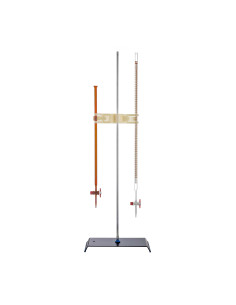
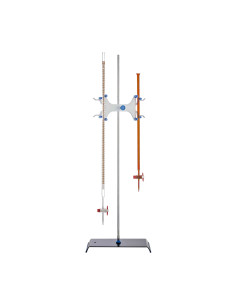
Volumetric analysis supports: designed for quantitative analysis workflows. Burette holders are especially relevant, enabling the burette to be held perfectly vertical for accurate meniscus reading.
Heating tripods: mainly used to support wire gauze or clay triangles over a Bunsen burner, enabling uniform heating of laboratory glassware.
Material selection for laboratory supports is deliberate. They must withstand not only mechanical load, but also ambient corrosion and chemical exposure.
Stainless steel: offers superior resistance to oxidation and strong acids, making it the preferred choice in pharmaceutical and organic synthesis laboratories.
Coated cast iron: bases are often cast iron to lower the setup’s center of gravity. Epoxy resin coatings or heat-resistant paint protect the metal from accidental spills.
Anodized aluminum: used in lighter structures and clamps, providing an excellent strength-to-weight ratio and easy cleaning.
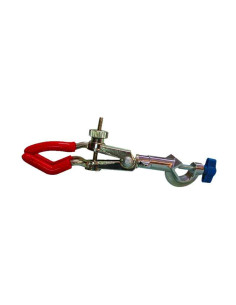
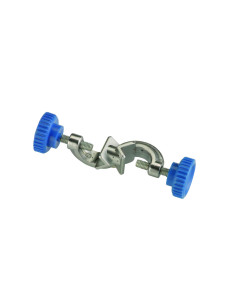
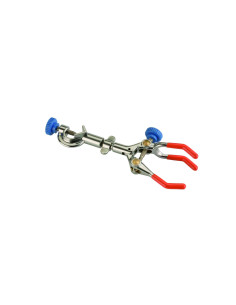
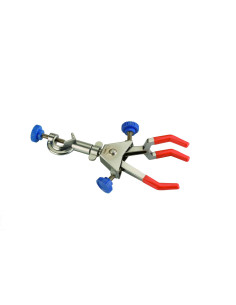
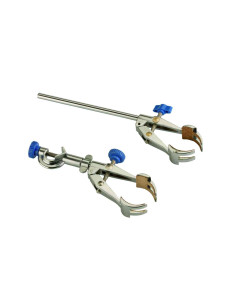
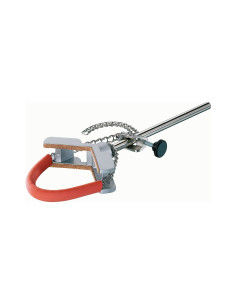
A support stand alone is simply an inert rod; its real functionality depends on the accessories you add. Double bossheads allow clamps to be connected to the main rod with secure fixation. In assemblies using flasks, three-prong clamps with cork or rubber coating are ideal, providing a firm grip without scratching or stressing the glass.
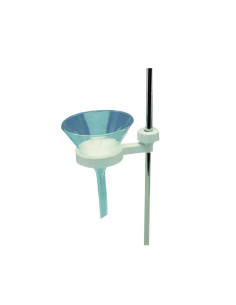
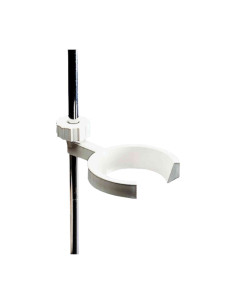
In mixture separation processes, metal rings are essential for supporting addition funnels and separatory funnels. These rings allow hands-free operation to manipulate stopcocks and perform phase separation with the precision required by the method.
In chemical titrations, vertical alignment and vibration-free stability are critical. The use of straight burettes requires anchoring that not only secures the glass but also enables rapid adjustment. Spring-loaded automatic clamps make it easier to place and remove the instrument without breakage risk—especially important when handling high-precision volumetric ware.
Even in microscale liquid handling, stability remains necessary. While manual micropipettes are hand-operated, benchtop holders prevent tips from contacting contaminated surfaces, protecting sample sterility and instrument calibration.
When laboratory supports are applied to complex systems, they form structural frameworks. In a Soxhlet extraction setup, a base must support a round-bottom flask, extractor, and an Allihn condenser, all aligned vertically. This typically requires longer rods to accommodate larger-volume extractors.
For automatic distillation systems, supports are often integrated into the equipment’s metal frame, ensuring precise alignment and reducing assembly-related human error.
Poorly maintained supports can become a serious hazard. It is essential to periodically check:
Base stability: ensure the base is level and that the rod is properly threaded and securely fixed.
Thread condition: bossheads and clamps should move smoothly. If rust is detected, clean with a wire brush or replace the component to prevent seizing.
Coating integrity: if the base paint is damaged, the iron is exposed to corrosion and the structure will lose strength over time.
Modern support system design also considers operator ergonomics. Adjustable laboratory stands enable work at an appropriate height, reducing visual fatigue when reading graduations on volumetric cylinders. In addition, modular rod systems mounted to walls or benches free up countertop space and support safer movement within the lab.
In facilities where gas measurements are routinely performed using gas manifolds, fixed support structures reduce the risk of accidental disconnections in vacuum or nitrogen lines.
The evolution of instrumentation is also reflected in these components. Today, bases with micrometric leveling systems and rods with advanced surface treatments that repel corrosive liquids are available. Even so, their essential role remains unchanged: to provide stable anchoring for scientific work.
Whether your focus is wine quality control using specialized flasks or petrochemical research, the selection of support structures directly impacts personnel safety and glassware service life. Do not compromise on quality: they are, quite literally, the foundation of your work.
The safety of your workspace depends on the quality of your clamping systems. At Pobel, we manufacture and distribute solutions engineered to withstand the most demanding conditions in modern chemistry. If you need to renew your inventory or design a specific setup for distillation or volumetric analysis, our technical team can support you.
Contact us to request a detailed quotation or technical product information.
 Quick delivery
 High quality
 Safe payment