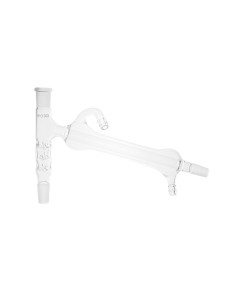


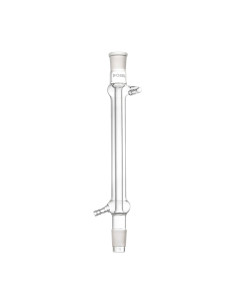
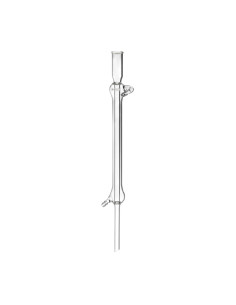
In laboratory distillation, few pieces of glassware are as simple and widely used as the Liebig condenser. Its straight, water-cooled design provides reliable vapour condensation and makes it particularly suitable for routine distillation, teaching laboratories, analytical chemistry and general laboratory applications.
A Liebig condenser, also known as a straight condenser, consists of an inner tube through which hot vapour passes and an outer jacket through which cooling water circulates. As heat is transferred from the vapour to the cooling medium, the vapour condenses and returns to the liquid state.
Compared with condensers designed to provide a larger heat-exchange surface, the Liebig condenser is characterised by its straightforward construction, ease of use and simple maintenance. It is therefore a practical choice for many applications where intensive condensation is not required.
You can also explore Pobel's complete range of laboratory condensers for other distillation, reflux and vapour condensation requirements.
The operation of a straight Liebig condenser is based on a simple tube-in-tube design that allows heat to be transferred efficiently from hot vapour to a circulating cooling fluid.
The condenser consists of two concentric glass tubes that create separate paths for the vapour and the coolant.
Liebig condensers are commonly manufactured from borosilicate glass, a material valued in laboratory applications for its chemical resistance and ability to withstand the temperature differences generated between hot vapour and cooling water.
For efficient operation, cooling water is normally introduced through the lower connection of the condenser and allowed to leave through the upper connection.
This arrangement helps keep the cooling jacket filled and creates counter-current heat exchange: the coolest incoming water comes into contact with the section where the vapour is closer to complete condensation, while warmer cooling water leaves near the hotter end of the apparatus.
The straight geometry provides reliable cooling for many standard applications, although its heat-exchange surface is lower than that provided by more complex condenser designs.
The simplicity, reliability and versatility of Liebig condensers make them suitable for a wide range of routine laboratory procedures.
Simple distillation is one of the most common applications for a Liebig condenser.
A liquid mixture is heated until the more volatile component evaporates. The resulting vapour enters the condenser, where it loses heat and returns to the liquid state before being collected in a receiving vessel.
A Liebig condenser can also be used vertically as a reflux condenser in suitable applications.
During reflux, solvent vapour rises from the heated reaction mixture into the condenser. After cooling and condensation, the liquid flows back into the reaction flask. This allows the mixture to remain heated for an extended period while reducing solvent loss.
For highly volatile solvents or processes requiring a larger cooling surface, other condenser designs may offer greater condensation efficiency.
The straightforward geometry of the Liebig condenser also makes it easy to incorporate into modular laboratory setups.
Different useful lengths and ground-glass joint configurations allow the condenser to be selected according to the scale of the experiment and the glassware used in the assembly.
The enduring use of the Liebig straight condenser is largely due to the practical advantages of its uncomplicated design.
The straight internal vapour path is easier to access and clean than more complex spiral or bulb configurations. This can be particularly useful when working with substances that leave deposits or residues inside the condenser.
Because there are no internal coils or bulbs in the vapour path, there are fewer areas where residues can accumulate and restrict the passage of vapour or condensate.
The tube-in-tube construction makes Liebig condensers straightforward to operate and suitable for routine use in research, quality-control and educational laboratories.
For many basic distillation procedures, the cooling capacity of a Liebig condenser is sufficient without requiring a more complex condenser design.
The simplicity of the straight design also means that it does not provide the same heat-exchange surface as condensers incorporating coils or other geometries.
For applications involving highly volatile solvents or greater vapour loads, a larger cooling surface may be preferable. Designs such as the Graham condenser or Dimroth condensers are designed to provide more intensive heat exchange.
The required condenser length should also be considered. Because the heat-exchange surface is primarily determined by the length of the straight inner tube, demanding applications may require a longer Liebig condenser to achieve sufficient cooling.
Correct installation helps ensure efficient condensation and protects the surrounding laboratory glassware.
When used for distillation, the condenser is normally installed with a slight downward inclination towards the receiving vessel. This allows the condensed liquid to flow naturally through the inner tube without accumulating inside the condenser.
The complete assembly should be securely supported using suitable laboratory clamps and stands, without placing excessive mechanical stress on the condenser or adjoining glass joints.
Cooling water should normally enter through the lower hose connection and leave through the upper connection. This helps maintain a completely filled cooling jacket and provides more effective heat exchange.
All hoses should be securely attached before starting the experiment to reduce the risk of leaks or accidental disconnection.
The condensed liquid should be collected in a vessel appropriate for the procedure being carried out. Where accurate volume determination is required, the distillate should subsequently be measured using suitable calibrated laboratory equipment rather than using the condenser or receiving vessel itself as a measuring instrument.
Several factors should be considered when selecting a Liebig condenser for laboratory use:
A longer condenser provides a greater heat-exchange surface, but the most suitable size should always be selected according to the actual requirements of the experiment.
Liebig condensers remain a practical and reliable solution for simple distillation, routine condensation and suitable reflux applications. Their straight design provides effective cooling while remaining easy to install, inspect and clean.
Pobel offers Liebig-West condensers manufactured from borosilicate glass 3.3 in different useful lengths and joint configurations, as well as versions without ground-glass joints and laboratory assemblies incorporating Liebig-West condensers.
If you need help selecting the appropriate condenser length, joints or configuration for your laboratory setup, contact our team for technical advice.
 Quick delivery
 High quality
 Safe payment