In a scientist’s day-to-day work, precision depends not only on mathematical formulas or reagent purity, but also on the physical integrity of experimental assemblies. Laboratory adapters act as the fundamental links that enable smooth transitions between different pieces of glassware, ensuring that distillation, filtration, or organic synthesis systems function as a tight and efficient unit. Without these connecting components, it would be virtually impossible to couple a round-bottom flask to a condenser when their joints have different diameters, underscoring their role as enablers of operational versatility.
When we speak of technical instrumentation, safety is a non-negotiable factor: a poorly fitted connection can lead to toxic vapor leaks, loss of vacuum, or, in the worst case, breakage due to mechanical stress. For this reason, understanding the anatomy of these connectors is vital for any professional seeking to optimize their processes. Below, we explore the technical depth of these accessories, from their manufacture in borosilicate glass to innovations in polymers that are transforming chemical resistance in the most demanding environmenTypes of connecting components according to geometry
The diversity of chemical experiments demands an equally varied range of coupling solutions. Not all assemblies are linear: many require branches, angular changes, or size reductions to control the flow of gases and liquids.
Reduction and expansion adapters
By far the most common items in any glassware cabinet, their function is simple yet critical: to allow the connection of a male ground joint to a female joint of a different size. Reduction models are used when the neck of the flask is larger than the piece of equipment to be inserted, while expansion adapters perform the opposite function. The standardization of joints (such as the widely used 24/40 or 14/23) ensures that these components are compatible with almost any research facility.
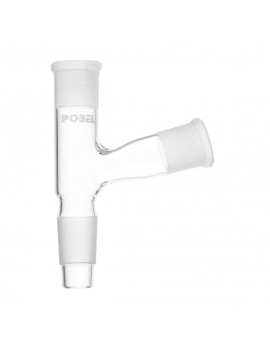
This component is a specialized variant that adds an additional neck to the assembly. It is primarily used in distillations where both a thermometer and an addition funnel must be inserted simultaneously into the same flask neck. The Y-shaped geometry of these adapters allows the system to maintain vertical alignment while diverting the vapor flow toward the condenser, preventing accidental splashing that could contaminate the final distillate.
Angular and bent connectors
In some cases, the physical space inside a fume hood limits assembly design. Couplings at 75, 90, or 105 degrees are essential for directing the distillation flow toward the receiving flask in a controlled manner. These elements ensure that condensate moves by gravity without accumulating in dead zones that could generate dangerous overpressure or reduce process efficiency.
Manufacturing materials: the science behind the glass
Material selection is not an aesthetic decision; it responds to the need to withstand extreme thermal gradients and constant chemical attack.
- Borosilicate glass 3.3: this is the gold standard in the industry. Its low coefficient of thermal expansion makes it resistant to thermal shock, allowing components to move from an open flame to an ice bath without fracturing. In addition, its transparency enables complete visual monitoring of the process. This is the preferred option at Pobel.
- PTFE (Teflon): frequently used in adapters that require constant rotation or where extremely strong bases are handled that could attack glass. Teflon connectors provide superior sealing without the need for silicone greases, which is critical in analytical chemistry to avoid cross-contamination.
- Polypropylene and technical polymers: although less common in high-temperature assemblies, they are excellent for vacuum systems or flexible tubing connections due to their impact resistance and low cost.
The role of laboratory adapters in distillation
Distillation is perhaps the process where these components demonstrate their full potential. In a typical fractional distillation setup, vapor must travel from the boiling flask, pass through a fractionating column, and finally enter the condenser. For this pathway to be efficient, laboratory adapters must ensure that no leak points exist where vapor can escape into the environment.
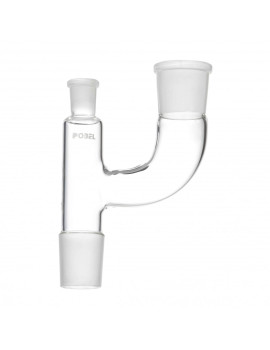
In this context, the vacuum adapter (also known as a “take-off adapter”) is a masterful piece of design. It features a side arm that allows connection to a vacuum pump or a nitrogen line, enabling distillation to be carried out under reduced pressure. This is essential for separating substances with very high boiling points or those that are thermolabile—that is, compounds that would decompose if heated at atmospheric pressure. The precision of the ground joints on these components ensures that the vacuum remains stable for hours, enabling reproducible results and high-fidelity purifications.
Maintenance and safety: caring for ground joints
An adapter is only as good as the condition of its ground joints. Wear, reagent crystallization, or excessive force can ruin a costly component and jeopardize an experiment.
Lubrication and sealing
To prevent components from seizing or becoming bonded due to heat and chemical exposure, laboratory greases are traditionally used. However, the modern trend favors PTFE sealing rings or self-lubricating joints. These not only facilitate disassembly but also prevent the introduction of greasy impurities into the sample—critical when working in pharmaceutical synthesis or forensic research.
Thorough cleaning
The accumulation of residues on the internal walls of connectors can alter fluid dynamics. The use of ultrasonic baths and specific solvents ensures that borosilicate glass regains its original chemical inertness. It is vital to periodically inspect components for “stars” or small fissures: under vacuum conditions, a microcrack can implode, projecting glass fragments and reagents toward the operator.
Innovations in modular connectivity
Technological evolution has not bypassed laboratory glassware. Today, we are witnessing a rise in quick-connect systems and modular adapters that incorporate sensors.
GL thread systems: allow plastic tubing or pH and temperature sensors to be connected directly to ground-glass necks, transforming a traditional adapter into a real-time monitoring port.
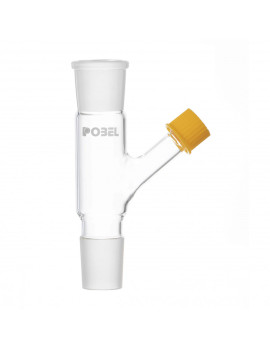
Multineck adapters with valves: enable reagent exchange in closed systems without breaking the inert atmosphere, an indispensable feature in modern organometallic chemistry.
Safety coatings: some models are now encased in a transparent polymer layer that, in the event of breakage, retains glass fragments and liquid contents, protecting personnel from accidental splashes.
Adaptability and precision in every experiment
Choosing the correct connector is a strategic exercise: it requires consideration of flow volume, system pressure, and material compatibility. A common mistake is using components with necks that are too long, causing premature vapor condensation and reducing the process’s energy efficiency. Conversely, an adapter that is too short may fail to provide sufficient mechanical stability, allowing the weight of the condenser to tilt the assembly and generate stress on the glass.
Ergonomics also play a key role. Modern designs include reinforced rims that improve grip when wearing safety gloves, reducing the risk of accidental drops. Ultimately, laboratory adapters are the silent heroes that ensure a scientist’s creativity is not constrained by the physical form of their tools.
Find the perfect solution with Pobel
At Pobel, we understand that every detail matters when it comes to research and quality control. With decades of experience in scientific glass manufacturing, we offer a product range that meets the most stringent international standards. If you are looking to optimize your assemblies or require a custom-made component for a special project, our technical team is ready to advise you with the professionalism and approachability your laboratory deserves.
The quality of our ground joints guarantees superior durability, reducing long-term replacement costs and improving technician safety. Do not let a poor connection compromise your results: trust experts who speak the language of chemistry.
Contact us for more information
If you have questions about which type of adapter is best suited to your setup or wish to request a customized quotation, we are fully at your disposal. Scientific excellence begins with the right equipment.
Visit our contact section to send us your questions or specific requirements. Our commitment is to respond with the speed your research demands, providing solid solutions to your daily challenges.



 Quick delivery
 High quality
 Safe payment