


DROPPING AND SEPARATING FUNNELS


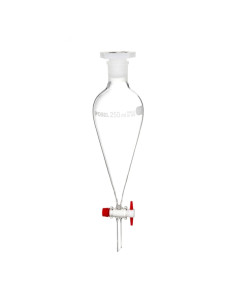
In advanced chemical synthesis and extraction, the success of an experiment often depends on the ability to precisely control liquid flow. Unlike simple transfer funnels, the laboratory stopcock funnel represents a leap in functionality, offering scientists the ability to start, stop, or regulate the flow of a liquid with millimetric precision. This level of control is vital when dosing sensitive reagents or separating immiscible liquid phases.
If your work involves the slow, monitored addition of a reagent to a glass laboratory reactor—where excessive speed could trigger an uncontrolled exothermic reaction—or if you need to meticulously separate an aqueous phase from an organic one, this type of funnel is your essential tool. Its design, which integrates a control valve (the stopcock) in the stem, transforms simple gravity into a highly reproducible dosing and separation process.
The defining feature of these utensils is the stopcock, but their applications fall mainly into two major categories based on body shape: addition funnels and separatory funnels.
These are the most familiar stopcock funnels, designed for the separation of immiscible liquid phases. Their shape is optimized for visualizing the interface.
Pear-Shaped (Squibb) Separatory Funnel: Its pear or conical shape allows the interface between two liquids to converge at a narrow point just above the stopcock. This enables precise separation of the lower phase, minimizing cross-contamination. Ideal for liquid-liquid extractions.
Cylindrical Separatory Funnel: Less common for general separations, but often used for large-volume separation or when directly connected to glass laboratory reactor systems for in-situ extraction. Enables separation in closed systems.
Amber Separatory Funnel: Made of amber or UV-protected glass, this model protects photosensitive reagents from degradation caused by ultraviolet light during extraction.
These funnels are used for the slow, gradual, and controlled addition of liquids to a reaction system.
Graduated Addition Funnel: With a cylindrical or slightly conical body and volume markings, it allows the chemist to measure and dose the reagent simultaneously. Ensures the addition of exact volumes.
Addition Funnel with Ground Joint: Essential for airtight assembly with flasks or the top ports of glass laboratory reactors. The ground-glass joint prevents vapor leakage and external moisture entry, ensuring system tightness.
The stopcock is the most important component of the funnel, as it is the direct control interface. Choosing the right material is critical and depends on chemical compatibility.
Universal Chemical Resistance: Borosilicate glass provides the best overall chemical resistance, compatible with nearly all acids, bases, and solvents.
Maintenance and Lubrication: Requires sealing grease to ensure a perfect vacuum and to prevent the stopcock from sticking. It is crucial to apply the grease in a way that prevents contact with the reagent, avoiding contamination.
Use: Preferred in applications where chemical inertness and long-term durability are top priorities.
No Lubrication Required: The PTFE (polytetrafluoroethylene) stopcock needs no grease, eliminating any risk of lubricant contamination and simplifying maintenance.
Solvent Resistance: Highly resistant to most common organic solvents, although its thermal resistance is lower than that of glass. Ideal for extractions with ether or chloroform.
Needle-Type Design: Some PTFE stopcocks feature a fine needle tip, allowing even more precise dropwise control—essential for extremely sensitive reactions in glass laboratory reactors.
Controlled dosing via a stopcock funnel is fundamental in any synthesis that is exothermic or requires a specific mixing rate.
Slow and Regulated Addition: When working with glass laboratory reactors, the ability to add a reagent drop by drop prevents dangerous temperature spikes that could cause a thermal runaway or decomposition of the desired product. The stopcock provides consistent flow-rate control.
Order-Sensitive Reactions: In reactions where local reagent concentration is critical, the stopcock funnel ensures that addition occurs slowly enough for the reagent to mix and react fully before the next portion is added.
After a reaction in a glass laboratory reactor, the mixture is often purified via liquid-liquid extraction.
Integration: The separatory funnel, with its precise control, can be attached to a modular system to perform the extraction directly within the reaction setup, minimizing sample handling.
Clean Separation: The stopcock allows the operator to drain the lower phase down to the last milliliter, stopping the flow exactly at the interface to achieve the cleanest possible phase separation—resulting in higher product purity.
A stopcock funnel requires more rigorous care than a simple funnel due to the complexity of its sealing mechanism.
Cleaning and Disassembly: The stopcock should be removed and thoroughly cleaned immediately after use. If reagents dry around it, they can cement the valve in place, risking breakage when turning.
Re-Greasing (Glass Stopcock): Re-greasing with the appropriate sealing compound is essential to maintain airtightness and smooth rotation. A dry stopcock may scratch, compromising the seal when attached to glass laboratory reactors.
PTFE Inspection: For PTFE stopcocks, ensure the compression fit (seal ring) is tight to prevent leaks, especially when handling low surface-tension organic solvents.
Visual Calibration: Before a critical addition to a glass laboratory reactor, perform a drip test with water or solvent, adjusting the stopcock until the desired drip rate (e.g., one drop per second) is achieved—standardizing reagent addition.
Proper Positioning: The funnel should be perfectly vertical so that the liquid column exerts uniform hydrostatic pressure, ensuring constant flow at a fixed stopcock opening.
Using a laboratory stopcock funnel is an investment in quality and reproducibility. By providing unmatched control over reaction kinetics and purification processes, it achieves:
Higher Yield: Controlled addition prevents the formation of unwanted by-products, maximizing conversion to the main product.
Traceability: Graduated stopcock funnels allow precise recording of reagent volume added to glass laboratory reactors over time—a vital factor for synthesis documentation.
Enhanced Safety: Flow control minimizes the risk of runaway reactions, protecting both the operator and valuable glassware.
Pobel stopcock funnels are designed for the controlled transfer and separation of immiscible liquids, as in extraction or decantation processes. They feature a glass or Teflon stopcock that allows precise regulation of flow and prevents material loss, ensuring safe and clean emptying.
Made of high-resistance borosilicate glass, they are ideal for work involving solvents, acids, or organic reagents.
Need technical advice or a customized quote? Contact us, and we’ll help you select the right model for your laboratory.
 Quick delivery
 High quality
 Safe payment

