


At the heart of any chemical process, temperature dictates the success or failure of a reaction. To ensure that the data obtained are reliable, the use of laboratory thermometer adapters is indispensable, as they allow sensors and measuring probes to be integrated into closed systems without compromising tightness. These components are not merely connectors: they are the bridge that ensures the sensor bulb remains in the exact position, surrounded by the vapor flow or immersed in the liquid, while preventing leaks that could alter system pressure or expose personnel to toxic vapors.
A professional distillation or organic synthesis setup requires every component to fit with millimetric precision. The ability to adjust the insertion depth of the measuring instrument without breaking vacuum or an inert atmosphere is one of the greatest advantages of these accessories. Below, we examine how material selection and connector design influence result reproducibility and the service life of scientific glassware.
The diversity of modern experiments has led to the development of specific configurations for each measurement requirement. Measuring temperature in a boiling flask is not the same as measuring it at the head of a fractionating column.
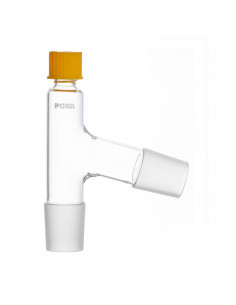
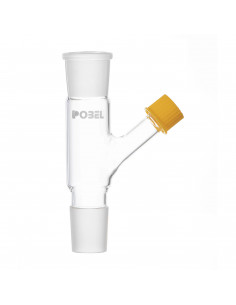
This is the most widely used design due to its exceptional versatility. It consists of a glass body with a ground-glass joint and an upper threaded section (commonly GL 14 or GL 18). Its functionality lies in the perforated screw cap and the internal polymer ferrule. When the cap is tightened, the ferrule compresses around the thermometer stem, creating a hermetic seal that allows the sensor to be moved up or down as required, enabling dynamic process control.
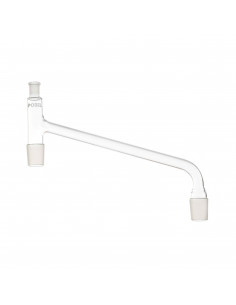
Although less common today for stem thermometers, these adapters are still used in assemblies where sensor position is fixed. They guarantee perfect alignment and eliminate the risk of accidental stem slippage. However, they lack the flexibility needed to adapt to different liquid volumes and are therefore typically reserved for dedicated measuring equipment or electronic sensors with integrated threads.
In many processes, the thermometer must enter the system at a specific angle to measure vapor temperature just before it enters the condenser. Angular models are designed to position the measurement point in the center of the vapor stream, preventing the sensor from contacting the glass walls, which would result in erroneous readings due to external thermal conduction.
The durability of laboratory thermometer adapters depends directly on the quality of their raw materials. Laboratory environments are inherently demanding, with corrosive vapors, extreme thermal gradients, and constant handling.
Borosilicate glass 3.3: the absolute industry standard due to its low coefficient of thermal expansion. Its resistance to thermal shock allows the component to withstand the heat of an open flame or heating mantle without fracturing, while maintaining the transparency required to verify that the sensor is unobstructed.
Polytetrafluoroethylene (PTFE): used in compression seals because of its universal chemical inertness. PTFE ensures that the adapter does not adhere to the thermometer stem and that sealing remains tight even when exposed to highly aggressive organic solvents.
Polypropylene and PBT: employed in screw caps due to their mechanical stability and resistance to moderate heat, allowing safe and ergonomic handling even when wearing protective gloves.
Not all connectors are equivalent, and an incorrect choice can result in wasted time and resources. When planning your setup, both chemical and physical compatibility must be carefully evaluated.
Compatibility with stem diameter:
It is essential to ensure that the adapter orifice matches the thermometer diameter (typically between 6 and 8 mm). An overly loose fit will cause leaks, while an excessively tight fit may exert dangerous mechanical stress on the glass, leading to accidental breakage during assembly. Modern systems often include interchangeable ferrules with different internal diameters to cover all use cases.
Ground-glass joint size:
The adapter’s ground joint (for example, 14/23 or 29/32) must fit perfectly into the neck of the flask or distillation head. Poor sealing at this interface would negate the benefit of the upper compression system. Precision glass grinding distinguishes high-quality components, ensuring tightness without the need for excessive silicone grease.
The use of laboratory thermometer adapters is standard practice across multiple scientific disciplines where thermal control is a critical parameter.
During the separation of liquid mixtures, knowing the exact boiling point of each fraction is essential. The adapter allows the thermometer bulb to be positioned just below the level of the side outlet on the distillation head. This ensures that the recorded temperature corresponds to vapor at equilibrium, maximizing distillate purity and preventing the collection of undesired fractions.
In long-duration reactions, continuous temperature monitoring is required to prevent degradation of the target compound or the formation of hazardous by-products. Threaded adapters allow the system to remain under an inert nitrogen atmosphere while the thermometer is monitored, providing a controlled and safe working environment throughout the reaction.
Laboratory safety begins with preventive maintenance of small components. A deteriorated adapter can be the source of unexpected glass breakage.
Inspection of polymer seals:
Over time and with heat exposure, PTFE or elastomeric seals may harden or deform. These components must be replaced to prevent the thermometer from slipping into the flask, which could damage both the sensor and the reaction vessel.
Removal of grease residues:
If silicone grease is used on ground joints, it must be completely removed after each use. Accumulated residues can carbonize under heat, complicating disassembly and increasing mechanical stress on borosilicate glass.
Verification of GL threads:
Glass threads are robust but not indestructible. They should be inspected for nicks or “stars,” as these defects prevent uniform tightening and compromise pressure integrity during experiments.
At Pobel, we understand that science is a discipline of precision, where safety and accuracy leave no margin for error. For this reason, we manufacture scientific glassware in accordance with the most demanding international quality standards, ensuring that every component reflects our commitment to technical excellence.
Our products are designed for long-term performance, offering chemical and thermal resistance that protects your investment and safeguards the integrity of your research. Choosing Pobel means trusting that every connection in your laboratory is secure, reliable, and engineered to perform.
If you need to upgrade your instrumentation or are seeking a specific solution for a complex setup, our technical team is ready to assist you.
You may contact us to resolve any questions or request a customized quotation. We will be pleased to support your future scientific projects with the quality assurance and expertise that only a leading brand can provide.
 Quick delivery
 High quality
 Safe payment