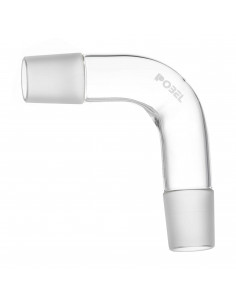




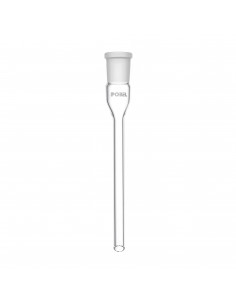
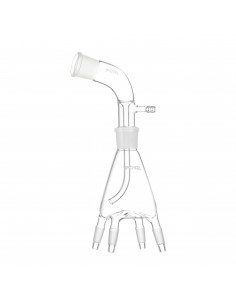
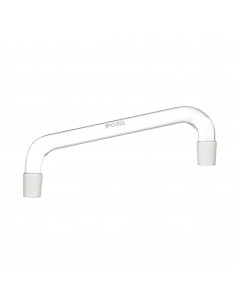

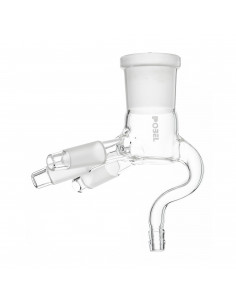


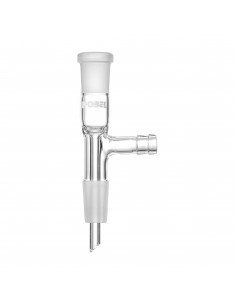

At the heart of any synthesis or purification laboratory, distillation stands as one of the oldest and most fundamental techniques. However, the effectiveness of this process depends not only on the heat source or the condenser, but on the quality of the connections: laboratory distillation adapters are the critical elements that ensure vapor flow is directed precisely toward the condenser without leaks or contamination. These specialized glass components make it possible to configure complex assemblies, adapting to the thermal and chemical requirements of each compound, and guaranteeing optimal performance in the production of pure distillates.
Understanding the function of each connecting bridge is vital for any technician or researcher: a poorly assembled system not only compromises sample purity, but also represents a latent safety risk. Handling volatile or flammable substances requires that every ground-glass joint fit perfectly, preventing the release of gases into the working environment. In the following sections, we analyze how these components facilitate phase transitions and why material design is the decisive factor between a failed experiment and a successful result.
Versatility in the laboratory is achieved through the use of components that allow modification of both the direction and the purpose of vapor flow. Depending on whether a simple, fractional, or vacuum distillation is required, the design of the accessory will change significantly.
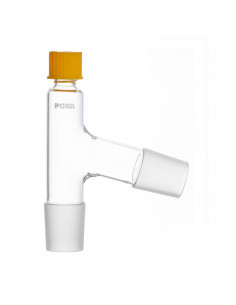
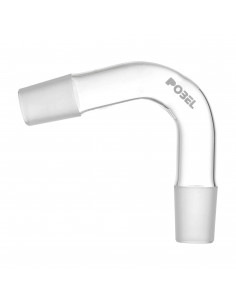
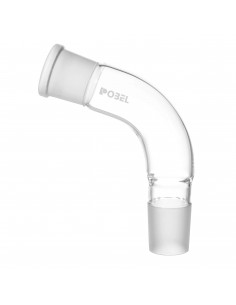
This is probably the most emblematic component in a standard setup. Its design allows the boiling flask, condenser, and thermometer to be connected at a single critical junction. The angular inclination of this device is calculated so that the vapor rising through the column comes into contact with the thermometer bulb before being diverted toward the cooling system, ensuring an accurate temperature reading that identifies the fraction being collected.
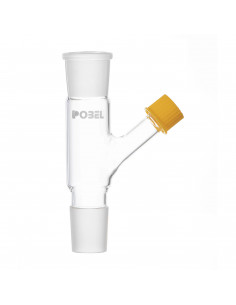
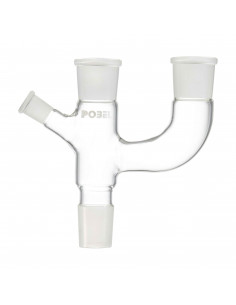
When the process requires additional monitoring or the introduction of reagents during boiling, Claisen geometry is employed. This component adds a parallel neck that minimizes the risk of boiling liquid splashing directly into the condenser (mechanical carryover), which is essential when working with mixtures that produce foaming or turbulent boiling.
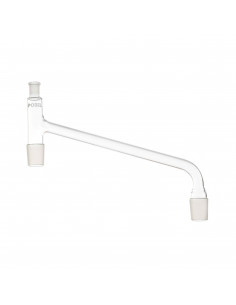
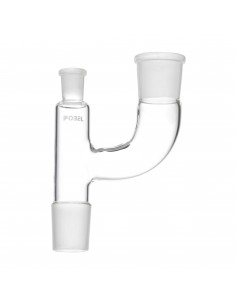
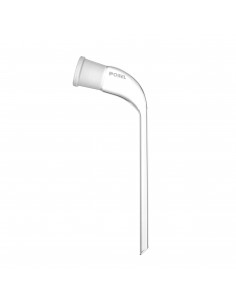
Once the vapor has been liquefied in the condenser, it must be guided into the receiving flask. Distillation take-off adapters or delivery adapters serve this final segment. They may be simple or incorporate a vacuum side arm, allowing the system to operate under reduced pressure for substances with high boiling points that could degrade under excessive heat.
The durability of distillation adapters is directly linked to the material from which they are blown. In professional environments, the use of borosilicate glass 3.3 is mandatory due to its superior thermal properties.
Low thermal expansion: this material withstands rapid temperature changes without fracturing, allowing transitions from intense heating to cold air exposure with complete safety.
Chemical inertness: result purity is preserved, as the glass does not react with most acids, bases, or organic solvents, preventing metal leaching or impurity release into the distillate.
Optical transparency: allows continuous observation of drip rate and the potential appearance of solid deposits or color changes in the flow, facilitating visual process control.
For mixture separation to be effective, the system must be hermetic. The ground finishes on connectors enable a mechanical seal without the need for rubber gaskets that could melt or react with vapors.
Standardized sizes: joints (such as 24/29 or 14/23) ensure that components from different manufacturers can be coupled, creating a modular and compatible glassware ecosystem.
Use of lubricants: for processes that do not require extreme vacuum, silicone grease is used, while in fine chemistry PTFE sealing rings are preferred to avoid grease contamination.
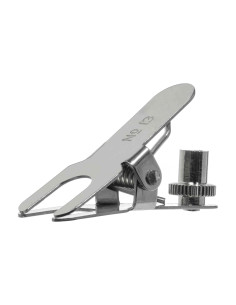
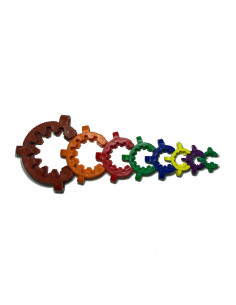
Joint clips: the use of safety clips (Keck clips) is essential to prevent internal pressure or component weight from displacing joints during heating.
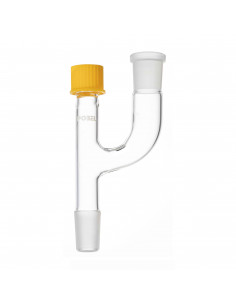
When working with essential oils or complex organic molecules, heat can be detrimental. In such cases, vacuum-specific distillation adapters are indispensable: they feature a lateral branch that connects to a pump or water aspirator.
By reducing internal pressure, the boiling point of liquids decreases significantly. This not only saves energy but also protects the structural integrity of thermolabile compounds. The design of these adapters must be robust, as the pressure differential between the exterior and the interior of the glass subjects the component to considerable mechanical stress. A high-quality vacuum adapter must have uniformly thick walls to prevent accidental implosions that could endanger laboratory personnel.
The longevity of technical equipment depends on rigorous preventive maintenance. Carbonized residues or salts embedded within connectors can create hot spots and weaken the glass.
Complete degreasing: after each use, it is vital to remove any traces of silicone grease from ground joints using solvents such as hexane or specific degreasing mixtures.
Ultrasonic baths: for complex adapter geometries that brushes cannot reach, ultrasonic cavitation is the most effective method to ensure microscopic-level cleaning.
Visual inspection: before assembling a system, the presence of “stars” or microcracks must be checked; under thermal conditions, these marks are precursors to imminent breakage.
Today, the design of these components has evolved to facilitate the analyst’s work. No longer are they expected merely to connect parts, but to provide solutions: some models incorporate polymer threads that allow digital thermometers to be inserted without risk of breakage or leaks.
Current trends point toward the development of more compact systems that reduce “dead space.” The shorter the path vapor must travel before reaching the condenser, the lower the loss due to premature condensation, resulting in higher energy efficiency and improved sample recovery. Precision in the outlet angle is therefore a matter of chemical engineering applied to glassware.
At Pobel, we know that every drop counts and that precision in your processes defines your professional success. As specialists in scientific glass manufacturing, we offer a range of components designed under the most stringent international quality standards. We do not merely sell equipment; we provide technical solutions that enhance the safety and reliability of your daily analyses.
Our products are engineered to withstand the test of time and the most demanding conditions of the chemical and pharmaceutical industries. If you are seeking a customized configuration or need advice on which type of glassware best suits your workflow, our team is ready to listen and provide the most appropriate technical solution.
Your research or quality control activities deserve the best technical support. If you need guidance on configuring your assemblies or would like to learn more about our range of borosilicate glass solutions, we will be pleased to assist you.
You can get in touch with us, and our team of experts will provide personalized attention to ensure that your laboratory reaches its full operational potential, with the guarantee and confidence that only a leading brand can offer.
 Quick delivery
 High quality
 Safe payment