

Simple distillation is one of the most fundamental separation techniques used in laboratory practice. It is based on differences in boiling points between the components of a liquid mixture and allows the separation or purification of substances through a controlled process of evaporation and condensation. Despite its conceptual simplicity, simple distillation remains an essential tool in chemical laboratories, teaching environments, industrial analysis and quality control.
This technique is particularly suitable when the components of a mixture have significantly different boiling points or when one component is non-volatile. Under these conditions, simple distillation allows the recovery of a relatively pure distillate without the need for complex equipment. For this reason, it is widely applied in academic laboratories, routine analyses, reagent preparation and solvent recovery processes.
Understanding what simple distillation is, how it works and what it is used for is essential for students, technicians and professionals working in laboratory environments.
What Is Simple Distillation
Simple distillation is a physical separation process in which a liquid mixture is heated until one of its components vaporizes. The vapor produced is then directed into a cooling system, where it condenses back into a liquid and is collected in a separate container.
The fundamental principle of simple distillation is that each pure substance has a characteristic boiling point. When a mixture is heated, the component with the lower boiling point evaporates first. If the difference between the boiling points of the components is sufficiently large, the vapor phase will consist predominantly of the more volatile component.
Unlike fractional distillation, simple distillation does not involve multiple equilibrium stages within a column. This limits its effectiveness when the boiling points of the components are close to each other.
Principle of Operation of Simple Distillation
The operation of simple distillation is based on the liquid–vapor equilibrium of a mixture subjected to heating. The process can be described as follows:
-
The liquid mixture is heated in a distillation flask.
-
As the temperature rises, the most volatile component reaches its boiling point.
-
This component vaporizes while less volatile substances remain mostly in the liquid phase.
-
The vapor travels through the distillation head toward the condenser.
-
Inside the condenser, the vapor is cooled and converted back into liquid form.
-
The condensed liquid, known as the distillate, is collected in a receiving vessel.
Precise temperature control is essential. Excessive heating may cause unwanted components to evaporate or lead to entrainment, while insufficient heating can reduce separation efficiency.
Materials Used in Simple Distillation
A simple distillation setup requires a basic but carefully assembled set of laboratory glassware and accessories. The most commonly used materials include:
-
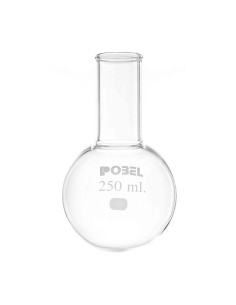
Round-bottom flask to hold the liquid mixture
-
Distillation head or outlet adapter
-
Thermometer and thermometer adapter
-
Straight condenser or Liebig condenser
-
Rubber or plastic tubing for cooling water circulation
-
Receiving flask or collection vessel
-
Heating source, such as a heating mantle or hot plate
-
Laboratory stand, clamps and supports
-
Ground-glass joints (male and female)
-
Angular adapters, if needed for orientation
These components form a closed and stable system that allows safe and efficient distillation under controlled conditions.
General Procedure for Simple Distillation
A standard simple distillation procedure typically involves the following steps:
-
Add the liquid mixture to the distillation flask, avoiding overfilling.
-
Assemble the distillation apparatus, ensuring all joints are properly fitted.
-
Position the thermometer so that the bulb is level with the vapor outlet.
-
Start the flow of cooling water through the condenser.
-
Apply heat gradually and in a controlled manner.
-
Monitor the temperature and observe vapor formation.
-
Collect the distillate as it condenses.
-
Stop heating when the temperature rises sharply or when the volatile component has been fully distilled.
This straightforward procedure enables effective separation in many laboratory applications.
What Simple Distillation Is Used for in the Laboratory
Simple distillation has numerous practical applications in laboratory work.
Purification of Liquids
One of the most common uses is the purification of liquids containing non-volatile impurities. As only the desired component vaporizes, impurities remain in the original flask.
Separation of a Liquid from Dissolved Solids
Simple distillation is ideal for separating a solvent from a solution containing dissolved salts or solids, such as producing distilled water from saline water.
Solvent Recovery
Many laboratories use simple distillation to recover organic solvents after reactions or extraction processes, helping reduce waste and operational costs.
Preparation of Reagents
The technique allows the preparation of reagents with sufficient purity for routine laboratory use, especially in preliminary or non-critical applications.
Teaching and Training
Simple distillation is a cornerstone of chemical education, as it clearly demonstrates key concepts such as boiling point, phase equilibrium and heat transfer.
Advantages of Simple Distillation
Simple distillation offers several advantages that explain its widespread use:
-
Simple and inexpensive setup
-
Minimal specialized equipment required
-
Easy to perform and control
-
Suitable for many common separation tasks
-
Ideal for educational and routine laboratory work
Its simplicity makes it accessible even in laboratories with limited resources.
Limitations of Simple Distillation
Despite its advantages, simple distillation has important limitations:
-
Ineffective when boiling points are close together
-
Lower purity for complex mixtures
-
Cannot separate azeotropes
-
Risk of entrainment if heating is not well controlled
When higher separation efficiency is required, more advanced techniques such as fractional or vacuum distillation are necessary.
Common Errors During Simple Distillation
Several common mistakes can negatively affect the outcome of the process:
-
Heating too rapidly
-
Incorrect thermometer placement
-
Insufficient cooling water flow
-
Overfilling the distillation flask
-
Poorly sealed joints causing vapor leaks
Avoiding these errors is essential for both safety and efficiency.
Comparison with Other Distillation Techniques
Simple distillation differs from other distillation methods in several ways:
-
Compared to fractional distillation, it provides lower separation efficiency.
-
Compared to vacuum distillation, it requires higher operating temperatures.
-
Compared to steam distillation, it is not suitable for high-boiling or thermally sensitive compounds.
Each technique has its own specific application range, and simple distillation remains the preferred choice for basic separations.
Conclusion
Simple distillation is a fundamental laboratory technique used to separate, purify and recover liquids when conditions allow. Its straightforward principle, low cost and ease of implementation make it an indispensable tool in daily laboratory practice. Although it has limitations compared to more advanced methods, simple distillation remains the first-choice technique for many routine, educational and preliminary separation tasks.