


Your cart
There are no more items in your cart
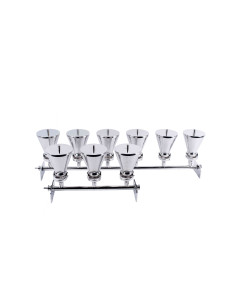
Filtration is a routine operation in many laboratories, but it can become a bottleneck when handling multiple samples. A filtration manifold (vacuum manifold) is designed to perform simultaneous filtration of several samples under vacuum, improving efficiency, repeatability, and process control.
These manifolds are common in microbiology, environmental testing, food and beverage quality control, pharmaceutical labs, and analytical workflows where multiple samples must be processed using the same protocol. They are especially widely used in membrane filtration (for example, microbial colony counts, water testing, sterile filtration workflows, and sample preparation).
This article explains what a filtration manifold is, how it works, typical applications, main types, and key technical criteria to select the right system.
A filtration manifold is a multi-position filtration system connected to a common vacuum collector. Each position typically includes:
A filter funnel or membrane holder
A membrane clamping/locking mechanism (depending on the design)
An outlet connected to a vacuum flask or collection container (often with a trap)
A connection to a vacuum pump or central vacuum line
The main advantage is the ability to perform the same filtration procedure in parallel, saving time and standardizing conditions across samples.
The system operates by pressure differential. When vacuum is applied:
The sample is poured into the funnel or filter holder.
The membrane or filter medium retains particles, microorganisms, or solids according to pore size.
The filtrate passes through and flows to the collection container.
Vacuum accelerates flow, enabling fast and consistent filtration.
Vacuum filtration is chosen when the goal is to:
Speed up filtration compared to gravity
Process medium-to-large volumes
Keep conditions consistent across multiple samples
Common laboratory uses include:
Membrane filtration in microbiology (followed by incubation and colony counting)
Water quality testing (potable, industrial, environmental)
Sample preparation for analytical methods (particle removal)
Filtration of media, buffers, and process solutions
Rapid filtration of fine precipitates (depending on filter selection)
In short, manifolds are used when laboratories need to process many samples uniformly and efficiently.
A full setup usually includes:
Filtration manifold (2, 3, 6, or more positions)
Funnel or membrane holder per position
Filter membranes (e.g., 0.45 µm, 0.22 µm, depending on method)
Vacuum flask or collection bottle
Vacuum trap (recommended to protect the pump)
Vacuum pump or vacuum line
Tubing and compatible connectors
Material selection (stainless steel, glass, technical plastics) affects chemical compatibility and cleaning.
Common in high-throughput labs due to durability and robust cleaning routines.
Typical advantages:
Long service life
Good resistance to many lab chemicals (grade-dependent)
Easy cleaning and maintenance
Often used when visibility of flow is helpful or where specific solvent compatibility is required. They require careful handling.
Typical advantages:
Good chemical compatibility depending on glass
Easy visual inspection of flow
Suitable for specific protocols
Some setups allow multiple funnel sizes or holder types, adapting the manifold to different volumes and workflows.
Key selection criteria include:
2–3 positions: moderate throughput
6+ positions: routine microbiology and quality control
Aqueous samples: typically easy to filter
Viscous or particulate samples: require more control and proper membranes
Pore size (0.45 µm vs 0.22 µm)
Membrane material (chemical compatibility)
Standard diameter (common in microbiology)
If sterile workflows are needed, choose designs that support effective disinfection/sterilization and easy cleaning.
Using a vacuum trap is strongly recommended to prevent liquid or aerosols from entering the pump.
A typical workflow includes:
Assemble manifold, collection bottle, trap, and pump.
Place membranes in each holder.
Secure membranes with the clamp/lock system.
Add samples to funnels.
Apply vacuum and monitor filtration rate.
Release vacuum safely and stop the pump.
Remove membranes (if required) for incubation or analysis.
Clean and disinfect/sterilize according to SOP.
Avoid excessive vacuum that can cause splashing or aerosols.
Always use a trap to protect the vacuum source.
Do not overfill funnels.
Check seals to avoid leaks and unstable filtration.
Follow a consistent cleaning protocol to prevent residue buildup.
In microbiology, minimize exposure during membrane handling.
Filtration manifolds are a key tool for laboratories that need to filter multiple samples quickly and consistently. By enabling parallel vacuum filtration, they improve throughput, reduce variability, and support standardized workflows—especially in microbiology and quality control.
Selecting the right manifold depends on sample volume, membrane type, sterility requirements, and vacuum system compatibility. With proper setup and maintenance, filtration manifolds become a highly efficient and reliable part of daily laboratory operations.
 Quick delivery
 High quality
 Safe payment