


Vacuum filtration is a physico-chemical separation technique used to separate solids from liquids quickly and efficiently. It is based on the principle of creating a pressure difference that accelerates the passage of the liquid through a filtering medium, leaving the solid retained. It is widely used in chemistry, biology, and pharmaceutical laboratories.
Principle of Vacuum Filtration
The process is based on applying negative pressure (vacuum) in the receiving flask, causing the liquid in the mixture to pass rapidly through the filter. The vacuum reduces flow resistance, allowing for a more efficient separation compared to gravity filtration.
Required Materials
The following equipment is required for vacuum filtration:
- Büchner funnel (porcelain or glass with perforated plate)
- Kitasato or filtration flask
- Filter paper or porous membrane
- Vacuum pump or water aspirator
- Vacuum-resistant hose
- Clamp or universal support stand
How Vacuum Filtration Is Performed
The vacuum filtration procedure consists of several steps that must be carried out carefully to ensure accurate and safe results:
1. System Preparation
Assemble the system by connecting the Kitasato flask to the Büchner funnel using a rubber adapter. Then, connect the flask to the vacuum pump using a resistant hose.
2. Placement of Filter Paper
Place a filter paper over the perforated plate of the Büchner funnel. To ensure proper sealing, slightly moisten the paper with the same solvent used in the filtration.
3. Activation of the Vacuum
Before pouring the mixture, turn on the vacuum pump to create negative pressure in the system. This ensures that the liquid will be efficiently drawn through the filter.
4. Filtration of the Sample
Slowly pour the mixture onto the Büchner funnel. The liquid passes into the flask due to the vacuum effect, while the solids remain retained on the filter paper.
5. Washing and Drying the Solid
If necessary, the retained solid can be washed with small portions of solvent to remove impurities. Afterward, maintain the vacuum for a few minutes to facilitate drying of the solid.
Uses and Applications of Vacuum Filtration
Vacuum filtration is used in numerous scientific and industrial fields:
- Chemistry laboratories:** separation and purification of synthesis products.
- Biotechnology:** isolation of biomolecules or cells.
- Pharmaceutical industry:** recovery of crystals or active solids.
- Water treatment:** separation of sediments and contaminants.
- Environmental analysis:** filtering liquid samples for contaminant measurement.
Advantages and Disadvantages
Main advantages of vacuum filtration include:
• Faster filtration compared to gravity filtration.
• Allows obtaining drier solids.
• Improves product recovery efficiency.
However, it also presents some disadvantages:
• Not suitable for volatile or highly viscous liquids.
• Filter paper can break if the pressure is too high.
• Requires equipment and vacuum system maintenance.
Conclusion
Vacuum filtration is an essential method for the rapid separation of solids and liquids. Its simplicity, efficiency, and adaptability make it an indispensable tool in modern laboratories and various industrial processes.
Related products
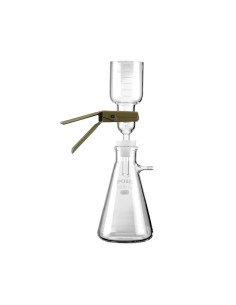
FILTRATION SET WITH FILTERING FLASK, STOPPER AND FILTER HOLDER
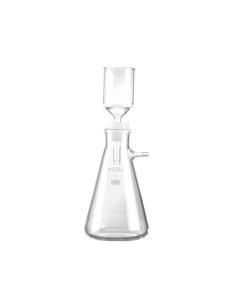
FILTRATION SET WITH FILTERING FLASK, STOPPER AND FUNNEL


