


Distillation is one of the oldest techniques used for the purification of substances. Its origins date back to Ancient Egyptian alchemists, who developed early systems to vaporize and condense compounds.
Over time, Greek and Arab scholars refined these methods, leading to the invention of the alembic and significant advances in evaporation and condensation processes. During the Middle Ages in Europe, key improvements were introduced, such as cooling systems, which laid the foundations for modern equipment.
With the Industrial Revolution and the development of technical glass, distillation equipment became more precise, resistant, and suitable for laboratory use. Since then, distillation has remained one of the most reliable and complete methods for obtaining high-purity water.
Distilled water: an essential element in the laboratory
In laboratory environments, water is not just a resource but a fundamental component in many processes. Its level of purity directly affects the reliability of results, making it essential to ensure the removal of impurities, ions, and contaminants.
Among the different purification methods, distillation has historically stood out for its ability to deliver high-quality water suitable for demanding laboratory applications.
Model 703: an early milestone in Pobel’s development
The Water Distiller Model 703 is one of the first distillation models developed by Pobel and represents an important stage in the company’s evolution within laboratory equipment manufacturing.
Designed to provide continuous and automated operation, this unit responded to the needs of its time, offering a practical solution for producing distilled water in laboratory environments.
Key features
The Model 703 incorporated several technical solutions aimed at efficiency and ease of use:
- Continuous production of up to 3 liters per hour, ensuring a steady supply of distilled water
- Automatic operation, requiring no constant supervision
- Water level control system, ensuring stable operation
- Automatic shut-off in case of cooling water failure, with automatic restart once supply is restored
- Easy maintenance, thanks to its tilting system for emptying
It was also capable of producing water with a specific conductivity of 1.5 µS/cm at 20 °C, free from metallic ions and pyrogenic substances.
Design and construction
The unit was composed of elements that reflect both the technology of its time and Pobel’s functional approach:
- Distillation flask
- Glass condenser system
- Quartz-sheathed heating elements (2 × 1,000 W)
- Silicone sealing components
- Support base
- Connection tubing
Its compact design (47 × 30 cm base and 60 cm height) allowed easy integration into laboratory settings.
A model that is part of our history
Although the Model 703 is no longer part of Pobel’s current catalog, it remains a representative example of the company’s early developments in water distillation.
This unit reflects an important stage in the evolution of our products, laying the groundwork for the solutions we offer today, adapted to the current needs of laboratory environments.
Related products
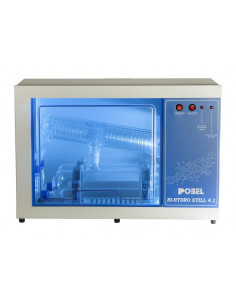
WATER STILL FOR DOUBLE DISTILLATION, MODEL BI-HYDRO - 4 L/H
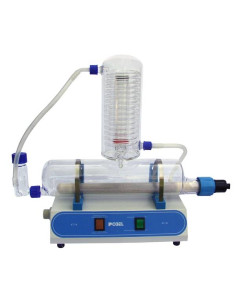


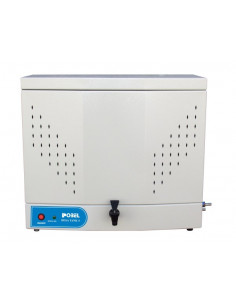
WATER STILL MODEL DETA, STAINLESS STEEL W/ TANK - 4 L/H AND 8 L/H


