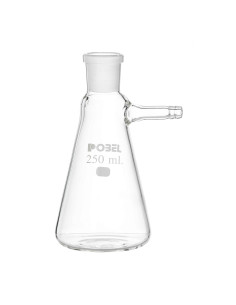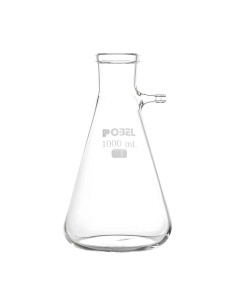


The Kitasato flask is a fundamental laboratory vessel designed to work under negative pressure and accelerate filtration processes. Its borosilicate glass body and lateral side arm allow it to be connected to vacuum systems, making it indispensable in chemical laboratories, microbiology, biotechnology, environmental testing, pharmaceutical analysis, and industrial research. The Kitasato flask serves as a reliable tool for improving the efficiency of laboratory procedures, ensuring rapid sample processing, and maintaining high standards of safety and experimental accuracy.
Characteristics of the Kitasato Flask
The Kitasato flask is commonly manufactured from borosilicate glass, a material that offers exceptional resistance to thermal shock, chemical corrosion, and mechanical stress. Its side arm enables secure attachment to vacuum pumps, creating negative pressure that significantly accelerates the filtration of suspensions and solutions. The conical body of the flask ensures uniform distribution of liquids and facilitates a tight connection with Büchner funnels, filter membranes, and specialized adapters. This structural efficiency maintains vacuum stability, prevents leakage, and enhances the reliability of analytical and preparative laboratory processes.
Main Applications
Vacuum Filtration
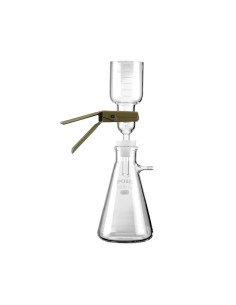
Vacuum filtration is the primary and most important application of the Kitasato flask. Unlike gravitational filtration, which relies solely on natural fluid descent, vacuum filtration uses negative pressure to accelerate the separation of solid and liquid phases. A Büchner funnel is placed on top of the flask, and a filter medium is used to retain solids while the vacuum pump removes liquid rapidly. This technique is widely applied in chemical synthesis, purification of reaction products, recovery of precipitates, microbiological sample preparation, and analysis of environmental contaminants. The consistent and rapid flow of liquid makes vacuum filtration essential in laboratories requiring efficiency and reproducibility.
Gas Collection
The Kitasato flask also plays a crucial role in controlled gas collection during chemical reactions. Its ability to maintain a sealed environment enables the safe capture of gases for analytical purposes, prevents harmful vapors from escaping, and preserves experimental integrity. It is used in environmental chemistry to collect decomposition products, in organic chemistry to capture reactive vapors, and in industrial laboratories to monitor emissions in air‑quality testing.
Use in Microbiology
In microbiology, the Kitasato flask is used for sterile filtration, handling of liquid cultures, and experimental setups requiring aseptic conditions. Its thermal resistance allows autoclave sterilization, ensuring that all equipment meets microbiological safety standards. The flask supports sterile vacuum filtration for media preparation and assists in minimizing contamination risks during culture manipulation, making it essential in laboratories focused on microbial growth, isolation, and analysis.
Advantages of the Kitasato Flask
Key Advantages
- Accelerates filtration processes considerably.
- Reduces contamination risk.
- Withstands negative pressure without structural deformity.
- Autoclave‑safe and easy to sterilize.
- Allows safe handling of gases and liquids.
- Provides high control and precision during experiments.
- Compatible with Büchner funnels, membranes, and laboratory adapters.
Conclusion
The Kitasato flask is an essential tool in modern scientific laboratories. Its robust design, versatility, and ability to operate under negative pressure make it indispensable for filtration, gas collection, and sterile liquid handling. From routine separations to advanced biotechnological applications, the Kitasato flask ensures efficiency, experimental precision, and reliable results. Selecting the appropriate model for laboratory needs enhances workflow efficiency and maintains high scientific standards.
Related products