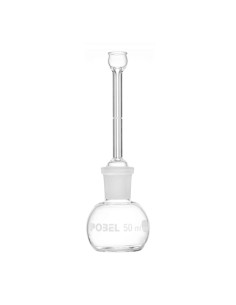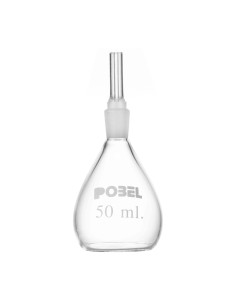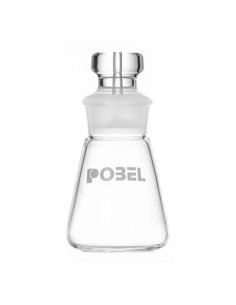


A laboratory pycnometer is a calibrated glass device used to determine the density of liquids and powdered solids with high precision. Its operation relies on measuring the mass of a known and constant volume, allowing the calculation of density under well-controlled temperature conditions. Because of its accuracy and reproducibility, the pycnometer is widely used in chemical laboratories, industrial quality control, petrochemical analysis, pharmaceutical development and research laboratories where density is a key physicochemical parameter.
Compared to other density measurement techniques, the pycnometer stands out for its simplicity, low cost and reliability. Since the volume of the instrument is fixed and precisely calibrated, density determination becomes a matter of accurate weighing and temperature stabilization. The method provides highly reproducible values that align with international standards, making pycnometers ideal for regulated analytical procedures.
The ability of a pycnometer to produce accurate density values is essential for many applications, including the characterization of unknown materials, verification of solvent purity, formulation of chemical products, control of raw materials and assessment of concentration or composition in solutions.
What a Pycnometer Is
A pycnometer is a glass vessel made of borosilicate and calibrated to contain an exact volume at a specified temperature, usually 20 °C or 25 °C. It typically includes a perforated stopper or a stopper with a narrow capillary through which excess liquid can escape. This ensures that the volume inside the pycnometer is always constant regardless of the operator.
Pycnometers are available in different capacities, from 5 mL to more than 100 mL depending on the requirements of the experiment. Several designs are commonly used, such as the Gay-Lussac pycnometer, the Sprengel pycnometer, the Hubbard pycnometer and relative density pycnometers. Although their shapes may differ, they all share the same fundamental operating principle: determining the density of a material by measuring the mass of a precisely known volume.
Borosilicate glass is used because it is chemically inert, highly resistant to thermal shock and transparent, allowing clear visual inspection and precise filling.
Principle of Operation
The operating principle of a pycnometer is based on the density equation:
density = mass / volume
Since the volume of the pycnometer is fixed and calibrated, density determination only requires accurate measurement of the pycnometer’s mass when empty and when filled with the test liquid. The difference between the two values corresponds to the mass of the liquid occupying the calibrated volume.
The procedure follows these conceptual steps:
-
Weigh the clean and dry pycnometer to obtain its empty mass.
-
Fill the pycnometer with the liquid sample, ensuring no air bubbles remain.
-
Insert the stopper, allowing any excess liquid to escape through the capillary.
-
Dry the outside of the pycnometer to avoid weighing errors.
-
Weigh the pycnometer again to determine the mass of the liquid inside.
-
Calculate the density using the measured mass and the known volume.
For powdered solids, a displacement method is used. The solid is first introduced into the pycnometer, then a reference liquid with known density is added. By measuring changes in mass, the true density of the solid can be calculated.
Temperature plays a critical role. Density varies significantly with temperature, so pycnometric measurements are always performed at a controlled and stable temperature.
Materials Used in Pycnometric Measurements
Several auxiliary tools are required to ensure accuracy and repeatability in density determination. These commonly include:
- Calibrated pycnometer made of borosilicate glass
- Analytical balance with high precision
- Thermostatic water bath for temperature stabilization
- Support stands and clamps
- Pipettes, syringes or rubber bulbs for filling
- Laboratory thermometer
- Watch glass
- Lint-free absorbent paper
- Reference substances for verification
All materials must be clean, chemically compatible and thermally stable to guarantee reliable results. Temperature control is one of the most important considerations, as density is extremely temperature-dependent.
General Operating Procedure
While the exact procedure may vary depending on the pycnometer type and analytical method, a standard pycnometric measurement typically includes the following steps:
-
Thorough cleaning of the pycnometer to remove contaminants or detergent residues.
-
Rinsing with distilled water and drying completely.
-
Weighing the empty pycnometer on an analytical balance.
-
Filling the pycnometer with the test liquid, avoiding trapped air bubbles.
-
Inserting the stopper and removing any excess liquid.
-
Drying the exterior without warming the instrument.
-
Weighing the filled pycnometer.
-
Computing density based on the mass difference and calibrated volume.
When working with solid powders, the powder is weighed inside the pycnometer before adding the reference liquid. After filling, the mass difference allows calculation of the solid density using displacement formulas.
Types of Pycnometers
Gay-Lussac Pycnometer
This classical model includes a stopper with a capillary that ensures a precise and reproducible filling level. It is typically used for low-viscosity liquids and is one of the most widespread designs in laboratory environments.
Hubbard Pycnometer
Widely used in petroleum analysis, this pycnometer is designed for viscosity-moderate or high-viscosity liquids. It is commonly used for oils, fuels and lubricants.
Sprengel Pycnometer
The Sprengel design is ideal for volatile or temperature-sensitive liquids. Its elongated form and sealed ends minimize evaporation and allow highly precise density determinations.
Relative Density Pycnometer
These pycnometers are used to compare the density of a test liquid against a reference liquid, typically water. They are useful in industrial quality control and characterization of unknown samples.
Applications of Pycnometers in the Laboratory
Pycnometers are essential in many fields of laboratory analysis and industrial production, including:
- Quality control of liquid products
- Purity assessment of solvents and reagents
- Density determination in oils, beverages and food products
- Characterization of organic and inorganic substances
- Evaluation of polymers, resins, fillers and construction materials
- Research in physical chemistry laboratories
- Calibration of densitometric instruments
Because density is a fundamental physical property, pycnometric analysis is widely used in the development of new materials and validation of industrial processes.
Advantages of Using a Pycnometer
Pycnometers offer several advantages over other density measurement methods:
- High accuracy and repeatability
- Simple operation and maintenance
- Low cost compared to digital densimeters
- Applicability to both liquids and powders
- No need for complex calibration procedures
- Consistency with international measurement standards
Their reliability makes them ideal for laboratories that require trustworthy results without dependence on electronic instrumentation.
Limitations
Despite their advantages, pycnometers also present certain limitations:
- Strong dependence on temperature stability
- Time-consuming procedure due to cleaning and drying steps
- Not suitable for highly viscous liquids unless using a specialized model
- Requires careful handling to avoid breakage
Nonetheless, their precision makes them a preferred method in analytical chemistry.
Conclusion
The pycnometer is a fundamental instrument for density determination in laboratory settings. Through a simple but rigorous method based on mass and volume measurements, it provides highly accurate and reproducible results. Whether measuring the density of liquids, powders or volatile substances, pycnometers remain indispensable tools in quality control, research, chemical analysis and industrial applications. Their robustness, simplicity and precision explain why they continue to be used as reference instruments in metrology and laboratory science.
Related products