

Degrees Baumé express a measurement related to the density of a liquid. In grape must analysis, this reading helps estimate concentration and potential alcohol. However, Baumé, Brix, density and alcohol percentage are not interchangeable quantities: each provides different information about the sample.
To interpret a result correctly, you need to know the instrument’s scale, its calibration temperature and the composition of the liquid. It is also necessary to distinguish a mathematical conversion from an estimate based on the behaviour of grape must.
At Pobel, we recommend starting with the measurement objective: density, an estimate of sugar content, potential alcohol or the alcohol actually present. That decision determines both the instrument and the measurement procedure.
What degrees Baumé are and how they are used
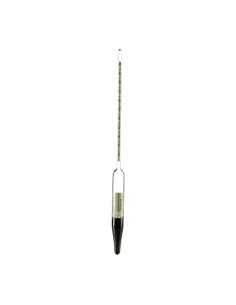
The Baumé scale, commonly written as °Bé, can be read using a flotation hydrometer. When placed in a liquid, the instrument reaches an equilibrium position related to the sample’s density. The reading is taken from the graduated scale on its stem.
In grape must, this measurement is used as an indicator of concentration. It can also help track fermentation, provided that comparable measurement conditions are maintained. During fermentation, the useful information is the trend in the readings, rather than treating every value as a direct determination of sugar or alcohol.
Different Baumé conventions exist for liquids heavier and lighter than water. The formulas for these scales are not the same, so any conversion must identify the convention being used.
Differences between Brix, density and alcohol content
Degrees Brix: a scale referenced to sucrose
In a solution containing only sucrose and water, 1 °Brix corresponds to 1 g of sucrose per 100 g of solution. This is a mass relationship, not a volume relationship: 20 °Brix does not mean 20 g of sugar per 100 mL.
In real grape must, the reading is interpreted against that reference even though the sample contains other substances. A Brix reading should therefore not be confused with a specific determination of all fermentable sugars. Converting to concentrations in g/L requires relationships or tables appropriate to the sample and method.
Density and specific gravity
Density is mass per unit volume and can be expressed in g/mL. Specific gravity, also called relative density or SG, is the ratio between the density of the sample and that of a reference; it has no units.
One reference used in oenology compares the sample and water at 20 °C, indicated as 20/20 °C. A specific gravity value must therefore not automatically be labelled as g/mL.
Alcohol content: alcohol present, not initial sugar
Alcoholic strength by volume is expressed as % vol, commonly referred to as ABV. In oenological analysis, its reference temperature is 20 °C. It must be distinguished from potential alcohol, which estimates what could be produced from fermentable sugars.
How to convert degrees Baumé to density
For a Baumé convention for liquids heavier than water, using modulus 145, the relationship is:
°Bé = 145 − 145 / d
Rearranging:
d = 145 / (145 − °Bé)
Here, d represents specific gravity under the scale’s reference conditions. The convention for sugar solutions at 20 °C uses specific gravity at 20/20 °C. Other conventions exist, so this formula must not automatically be assigned to every instrument.
For example, applying that convention to a reading of 12 °Bé:
d = 145 / (145 − 12) ≈ 1.0902
The result is dimensionless. To express it as density at 20 °C, multiply by the density of water at that temperature, approximately 0.998203 g/mL:
ρ₂₀ ≈ 1.0902256 × 0.998203 ≈ 1.0883 g/mL.
This example shows why it matters whether a table gives density or specific gravity. Before using a conversion table, check its modulus, reference temperatures and compatibility with the hydrometer documentation.
How to convert degrees Baumé to Brix
A practical approximation used in winemaking is:
°Brix ≈ 1.8 × °Bé
The reverse conversion is:
°Bé ≈ °Brix / 1.8
This is a working approximation, not an exact equivalence for every liquid or concentration.
Indicative conversion table
The following values are examples calculated using that approximation:
| Degrees Baumé | Approximate degrees Brix |
|---|---|
| 8 °Bé | 14.4 °Brix |
| 10 °Bé | 18.0 °Brix |
| 12 °Bé | 21.6 °Brix |
| 14 °Bé | 25.2 °Brix |
This table is suitable for an initial estimate. For an analytical report, use the conversion table that corresponds to the instrument, temperature and sample type.
Do not apply a sugar equivalence to a salt solution or another product simply because it gives the same Baumé reading. Matching density does not demonstrate matching composition.
Relationship between degrees Baumé and alcohol content
Potential alcohol of grape must
The traditional rule that approximates the Baumé value to potential alcohol percentage does not guarantee the final result. A more specific estimate starts with fermentable sugars. One reference calculation is:
Potential alcohol (% vol) ≈ fermentable sugars (g/L) / 16.83
The factor is not universal: the effective conversion depends on fermentation conditions.
For example, with 200 g/L of fermentable sugars, this relationship gives approximately 11.9% vol potential alcohol. It is a prediction, not a measurement of the finished wine.
The OIV oenological table also distinguishes these quantities: for a refractometric reading equivalent to 22% sucrose by mass, it lists 214.7 g/L sugars and a calculated potential strength of 12.76% vol. These values are not presented as an identity between Brix and alcohol.
Actual alcohol content of wine
Determining the alcohol present in wine requires more than converting a Baumé reading or placing an alcoholmeter directly in the sample.
The OIV method for determination by alcoholometry includes preparing a distillate and subsequently measuring it. This separates the alcohol from non-volatile components that would affect the interpretation of density. Estimating must potential and analysing finished wine are different operations.
Which instruments to use in the laboratory
Baumé hydrometers
Baumé hydrometers allow measurements directly in °Bé. Pobel’s documentation lists instruments calibrated at 15 °C and the possibility of manufacture for 20 °C, with different ranges and scale divisions depending on the reference.
Select an interval that includes the expected readings. When small variations need to be distinguished, also review the scale division and documented metrological characteristics. Finer graduations should not, on their own, be interpreted as a guarantee of a particular measurement accuracy.
Hydrometers for wine
Hydrometers for wine are intended for density measurements within their application range. Pobel lists models calibrated at 20 °C, with ranges such as 0.990–1.005 and 0.980–1.030.
An especially important detail is that these models specify reading at the top of the meniscus. Instructions to read the bottom of the meniscus must not be applied automatically.
Also check that the instrument’s interval covers your sample: a wine hydrometer does not necessarily replace an instrument intended for more concentrated grape must.
Alcoholmeters
Pobel’s alcoholmeters indicate ethanol percentage by volume and are calibrated at 20 °C. The catalogue lists different intervals so that the instrument can be selected for the intended test.
A direct reading applies to suitable mixtures of water and ethanol. The presence of sugar or other components means that not every beverage can be treated as a simple hydroalcoholic mixture. Complex samples require the appropriate analytical procedure.
Must meters
Must meters support grape must monitoring through scales adapted to oenological work.
Pobel lists dual-scale models calibrated at 20 °C. The documented configurations include a density scale of 0.990–1.130 alongside 0–16 °Bé, and another incorporating a potential alcohol scale. That potential alcohol indication is not equivalent to measuring the ethanol already present.
Graduated cylinders
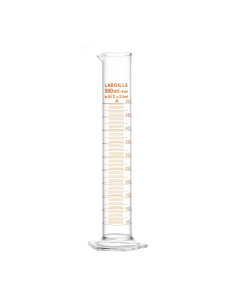
Graduated cylinders can hold the sample during a flotation measurement. Choose a height and diameter that allow the instrument to be immersed without touching the bottom or sides.
Do not select the cylinder solely by its nominal capacity. Also consider the space needed for the hydrometer body, its immersion depth and visibility of the reading. In this test, the cylinder’s volume scale does not replace the scale on the measuring instrument.
How to take a measurement correctly
Prepare a representative sample
Identify the sample and follow the specified procedure for homogenising and conditioning it. Where interfering solids are present, apply the preparation required by the method. Also check that the instrument is clean and free from adhering bubbles.
Avoid accidental dilution from residual washing water. When comparing batches, maintain the same sampling and preparation criteria so that the results can be interpreted consistently.
Control temperature and flotation
Work at the reference temperature or apply a documented correction appropriate to the instrument and sample. Do not use a generic correction interchangeably for Baumé, Brix and alcoholometry. Flotation measurements are sensitive to temperature.
Lower the instrument gently and check that it floats freely. A reading taken while the instrument rests against the container does not represent its free-floating equilibrium position.
Read and record the result
Follow the specified meniscus convention. Temperature, meniscus reading and the instrument’s surface conditions can contribute to measurement error.
Record the observed value, scale, temperature, instrument identification and any corrections applied. When calculating an equivalent value, also record the formula or table used. This separates the measured reading from the calculated result and makes the calculation easier to review.
Common mistakes and safety
The most important mistakes are confusing density with specific gravity, presenting an approximation as an exact conversion, and treating potential alcohol as measured alcohol.
It is also important to avoid using an instrument outside its range or comparing readings obtained through different procedures.
Before starting, inspect the glassware and use a stable work surface. Define personal protection and handling precautions through the risk assessment and relevant safety data sheets. Store instruments in protective conditions and remove damaged items from service.
Frequently asked questions about degrees Baumé
Does 12 degrees Baumé mean 12% alcohol?
Not necessarily. A reading of 12 °Bé describes the sample through a scale related to its density. Determining actual alcohol requires an appropriate measurement; it cannot be achieved simply by changing the unit attached to the result.
Can a must meter be used during fermentation?
It can be used to follow changes when its range and the procedure are suitable. However, a reading taken during fermentation must not automatically be interpreted as a direct measurement of residual sugar or alcohol.
Are all instruments read at the bottom of the meniscus?
No. Follow the manufacturer’s instructions. The wine hydrometers described in Pobel’s catalogue specify reading at the top of the meniscus.
Choose the correct scale before converting
Converting between degrees Baumé, Brix, density and alcohol content starts with correctly identifying the measured quantity. The next step is selecting a relationship that is valid for the sample and working conditions.
At Pobel, we recommend reviewing the instrument, its range, temperature and procedure together. This helps prevent a correct reading from being turned into an incorrect conclusion.