


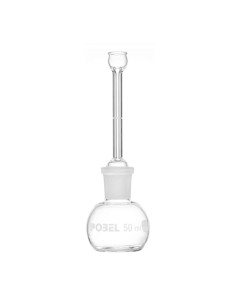
Pycnometers for solids are laboratory instruments used to determine the density of solid materials through a procedure based on the sample’s mass and the volume it occupies or displaces within the measurement system.
At Pobel, you can find pycnometers specifically intended for determining the density of bituminous materials and minerals. These models are made from borosilicate glass 3.3 and calibrated at 20 °C.
This product family is part of our range of laboratory pycnometers, which also includes instruments designed for other sample types and procedures.
A pycnometer for solids is a laboratory vessel designed to determine the density of a solid sample through displacement and weighing.
Unlike pycnometers intended exclusively for liquids, these instruments allow a solid sample to be placed inside the vessel and its volume to be determined using the liquid employed during the test.
The sample’s density can be calculated from the masses obtained during the procedure and the conditions specified by the method used.
The main function of a pycnometer for solids is to determine the density of solid materials by pycnometry.
Pobel specifies the models in this category for determining the density of bituminous materials and minerals. These instruments are therefore particularly suited to analysing these types of samples.
Density is a physical property that relates a substance’s mass to the volume it occupies. To determine it correctly by pycnometry, a defined procedure for sample preparation, weighing and filling must be followed.
Density determination using a pycnometer involves performing several weighings and using a liquid to establish the volume occupied by the solid sample.
In general, the procedure compares the masses of the vessel, sample and liquid at different stages of the test. These data allow the solid’s volume to be determined and its density to be calculated.
The exact procedure depends on the analytical method used. The specified conditions for sample preparation, weighing, temperature and pycnometer filling must therefore be followed.
The pycnometers for solids sold by Pobel are specifically intended for determining the density of bituminous materials and minerals.
This application is stated directly in the product specifications, making these models suitable when the laboratory procedure requires pycnometry to analyse these types of materials.
Before carrying out the test, check that the sample’s characteristics and the method used are compatible with the selected instrument.
Pobel’s models are made from borosilicate glass 3.3.
The instrument’s material is one of the specifications to consider when selecting laboratory equipment, particularly when the procedure requires defined temperature and handling conditions.
Pobel uses borosilicate glass 3.3 for all three capacities available in this range.
Pobel’s pycnometers for solids are calibrated at 20 °C.
Temperature is relevant to density determination because it can affect the properties of the liquid used during the procedure and, consequently, the test result.
The temperature conditions specified by the analytical method must therefore be followed, taking into account that these instruments are calibrated at a reference temperature of 20 °C.
Pobel offers three capacities in this range:
The different capacities allow the instrument to be selected according to the amount of sample and the conditions specified by the laboratory procedure.
The capacity should be selected according to the test method and the amount of sample required for the determination.
Within Pobel’s available range, the 500 ml model has a 45/40 ground-glass joint, while the 1000 and 2000 ml versions have a 60/46 ground-glass joint.
Before selecting a model, check:
Both instruments are used to determine density, but their configuration and the procedure depend on the sample type.
A conventional liquid pycnometer holds a known volume of liquid sample and determines its density by weighing. For solids, the procedure must allow the sample’s volume to be determined using the liquid employed during the test.
It is therefore important to use a pycnometer designed for the sample type and the corresponding analytical method.
If you need to determine the density of liquids, you can also explore our Gay-Lussac pycnometers.
Pycnometers and hydrometers can both be used for density measurements, but they use different procedures.
Conventional hydrometers are designed to work directly with liquids, while pycnometers for solids allow measurements on solid samples through a pycnometric procedure.
The exact procedure must be specified by the test method used, but density determination by pycnometry requires careful control of the different preparation and weighing stages.
Factors to consider include:
The determination must always follow the laboratory method applicable to the sample being analysed.
It is used to determine the density of solid materials through a pycnometric procedure based on weighing and determining the sample’s volume.
Pobel specifies these pycnometers for determining the density of bituminous materials and minerals.
The available models are made from borosilicate glass 3.3.
Pobel’s pycnometers for solids are calibrated at 20 °C.
Pobel offers models with capacities of 500, 1000 and 2000 ml.
The 500 ml model has a 45/40 ground-glass joint, while the 1000 and 2000 ml models have a 60/46 ground-glass joint.
Explore our range of pycnometers for solids and select the capacity and ground-glass joint size that best suit the procedure you need to carry out. If you are unsure which model to use for analysing your sample, contact the Pobel team for advice.
 Quick delivery
 High quality
 Safe payment
