


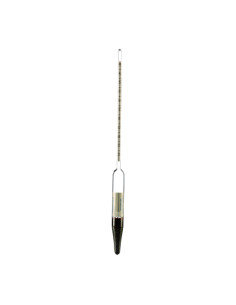
Wine hydrometers are laboratory instruments used to measure density in samples associated with oenological analysis. They work by flotation and provide a direct reading on a graduated scale.
In wine and must analysis, density is a physical parameter that can be determined using various methods, including hydrometry. The hydrometers in this category are specifically designed for these measurements.
The models available from Pobel are calibrated at 20 °C, are read at the top of the meniscus and are supplied with a batch certificate.
A wine hydrometer determines the density of a liquid sample by flotation.
Density expresses the relationship between a substance’s mass and the volume it occupies. For wines and musts, this property can form part of various oenological analysis procedures.
The International Organisation of Vine and Wine provides for the determination of the density and specific gravity of wines and musts by hydrometry, using graduated instruments that operate according to Archimedes’ principle.
Its operation is based on Archimedes’ principle. When placed in the sample, the hydrometer becomes partially submerged and reaches an equilibrium position determined by the density of the liquid.
The higher the sample’s density, the smaller the volume the instrument needs to displace to balance its own weight. Its floating position produces a reading on the hydrometer’s graduated scale.
For the measurement to be valid, the instrument must float freely, and the reading must be taken under the conditions specified for the procedure used.
The wine hydrometers sold by Pobel are calibrated at 20 °C.
This reference temperature is particularly relevant because the density of liquids changes with temperature. The OIV also uses 20 °C as the reference temperature for expressing density and specific gravity in wine and must analysis.
The sample temperature must therefore be taken into account during measurement, and the appropriate procedure must be followed when conditions differ from the reference conditions.
One specific feature stated by Pobel for these hydrometers is that the reading is taken at the top of the meniscus.
The meniscus is the curved liquid surface that forms around the instrument’s stem. The way the reading should be taken depends on the hydrometer’s design and the method for which its scale has been calibrated.
It is therefore important always to follow the reading instructions for the model being used, rather than automatically applying the same procedure to every type of hydrometer.
Although these instruments can all be used in oenology, wine hydrometers, must hydrometers and alcoholmeters are not equivalent.
Choosing the correct instrument therefore depends on the parameter to be measured and the analytical procedure used.
Measuring density and determining alcohol content are different procedures.
A wine hydrometer provides information about the density of the sample, but this does not mean that any density reading can be converted directly into alcohol content without applying the appropriate method.
Official wine analysis methods may require specific sample preparation procedures to determine alcohol content. If the aim is to measure alcohol content, the equipment and method specified for that analysis must therefore be used.
If you specifically need to measure the percentage of ethanol, you can also explore our laboratory alcoholmeters.
The choice depends on the quantity you want to measure.
If the aim is to determine the density of wine by hydrometry, use a hydrometer suitable for oenological analysis. If you are analysing must and need specific scales such as degrees Baumé or potential alcohol content, a must hydrometer may be more suitable.
Before selecting an instrument, check both the sample to be analysed and the scale required by the procedure.
To take a measurement, place the sample in a container that allows the instrument to float freely. Carefully lower the hydrometer into the sample and allow it to stabilise before taking the reading.
During the procedure, check that:
The temperature and reading criteria must comply with the instrument’s calibration conditions and the analytical method used.
Before buying a wine hydrometer, it is important to identify the parameter to be determined and the procedure to be used.
Factors to review include:
If you need an instrument for a different measurement, you can also explore our general range of laboratory hydrometers.
It is used to measure density in samples associated with oenological analysis, using the principle of flotation.
The models sold by Pobel are calibrated at 20 °C.
Pobel specifies that these hydrometers must be read at the top of the meniscus.
No. Both can be used in oenology, but they are intended for different measurements and scales. A wine hydrometer determines density, while a must hydrometer is specifically designed for must analysis and may include additional scales.
Not necessarily. Density and alcohol content are different parameters. Determining alcohol content requires following the appropriate analytical method.
Yes. Pobel specifies that they are supplied with a batch certificate.
Explore our range of wine hydrometers and select the instrument suited to the analytical procedure you need to carry out. If you are unsure which model to use or need help distinguishing between a wine hydrometer, a must hydrometer and an alcoholmeter, contact the Pobel team for advice.
 Quick delivery
 High quality
 Safe payment