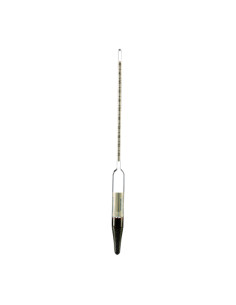


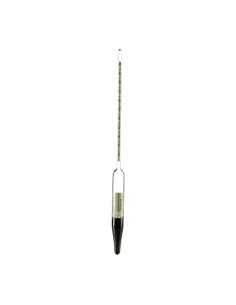
Specific gravity hydrometers are laboratory instruments used to determine the specific gravity of liquids by flotation. They provide a direct reading on a graduated scale, provided that an instrument with a suitable range for the sample’s expected values has been selected.
At Pobel, you will find specific gravity hydrometers with different measuring ranges and scale divisions for measuring liquids in the laboratory. This product family is part of our range of laboratory hydrometers.
Specific gravity is the ratio of a substance’s density to the density of a reference substance. For liquids, the reference substance is water under specified temperature conditions.
Since it is a ratio between two densities, specific gravity has no units. Hydrometers designed for this measurement therefore feature numerical scales that provide the corresponding value directly.
Temperature conditions are important because the density of liquids changes with temperature. Hydrometers therefore specify the reference conditions associated with their calibration.
A specific gravity hydrometer works by floating in a liquid. When placed in the sample, it reaches an equilibrium position that depends on the density of the liquid.
This behaviour follows Archimedes’ principle. The instrument experiences a buoyant force equal to the weight of the displaced liquid and sinks until it reaches equilibrium.
Once the hydrometer has stabilised, the reading is taken directly from its graduated scale.
No. Although closely related, density and specific gravity are not exactly the same quantity.
Density expresses the relationship between a substance’s mass and volume and is given in units of mass per unit volume. Specific gravity, on the other hand, compares the density of the sample with that of a reference substance. As a ratio between equivalent quantities, it has no units.
This distinction explains why it is important to select a hydrometer with a scale that corresponds to the parameter you need to determine.
Pobel offers specific gravity hydrometers with 0.001 scale divisions. According to the product catalogue, models are available with the following ranges:
Models covering the ranges between 0.600 and 1.300 are specified at 15/15 °C. The model with a range of 1.900–2.000 is specified at 20/20 °C.
Models with 0.005 scale divisions are also available. The ranges specified by Pobel include:
These models are specified at 15/15 °C.
The choice between 0.001 and 0.005 scale divisions will depend on the range and graduations required for the measurement procedure.
The designation 15/15 °C refers to the temperatures used to express the specific gravity ratio: the density of the sample at 15 °C is compared with the density of water at the same temperature.
Similarly, a 20/20 °C specification uses 20 °C as the reference condition.
Temperature must be taken into account during these measurements because a change in temperature can alter the liquid’s density and consequently affect the reading.
According to Pobel’s specifications, its specific gravity hydrometers are manufactured in accordance with UNE 400326, UNE 400311-1-2, ISO 387 and ISO 649-1.
The instruments are supplied with a batch certificate and can also be supplied with a calibration certificate upon request.
ISO 387 establishes principles relating to the construction and adjustment of constant-mass glass hydrometers, including aspects such as the basis of the scale, reference temperature and reading conditions.
To perform the measurement, place the sample in a container that allows the hydrometer to float freely. Carefully lower the instrument into the sample and wait until it reaches a stable position before taking the reading.
During the procedure, check that:
Working under the appropriate reference conditions is particularly important when comparing results from different measurements.
Before selecting a specific gravity hydrometer, you need to know the approximate range within which the sample’s specific gravity is expected to fall.
The main parameters to check are:
Selecting a range close to the values you expect to measure provides a scale suited to your procedure.
It determines the specific gravity of a liquid by flotation, providing a direct reading on the instrument’s graduated scale.
No. It is a ratio between two densities, so the result is dimensionless.
Pobel offers specific gravity hydrometers with 0.001 and 0.005 scale divisions, depending on the model.
No. Most models listed in the catalogue are specified at 15/15 °C, while the model with a range of 1.900–2.000 and 0.001 scale divisions is specified at 20/20 °C.
Yes. Pobel states that these hydrometers are supplied with a batch certificate and can also be supplied with a calibration certificate upon request.
Explore our range of specific gravity hydrometers and select the measuring range, scale division and reference conditions that best suit your measurement procedure. If you are unsure which model you need, contact the Pobel team for advice.
 Quick delivery
 High quality
 Safe payment