


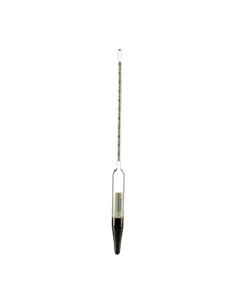
Alcoholmeters are measuring instruments used to determine the percentage of ethanol in mixtures of water and alcohol. They provide a reading of the alcohol content as a percentage by volume by floating in the sample.
The alcoholmeters available from Pobel are calibrated at 20 °C and are offered in different graduation ranges, from low concentration values to models capable of measuring between 90 and 100% vol.
These instruments are specifically designed for alcoholometry and form part of Pobel’s range of laboratory measuring equipment.
An alcoholmeter is a glass instrument designed to indicate the ethanol concentration in a mixture of water and ethanol. Depending on the type of instrument, the alcohol content may be expressed as a percentage by volume or a percentage by mass.
The models supplied by Pobel specifically indicate the percentage of ethanol by volume and are calibrated at a reference temperature of 20 °C.
Percentage by volume expresses the volume of ethanol present in a given volume of the mixture, with both volumes referenced to the same temperature. In alcoholometry, this reference temperature is usually 20 °C.
An alcoholmeter works according to Archimedes’ principle. The instrument is placed in a liquid mixture and floats at a certain depth depending on the density of that mixture.
In a mixture of water and ethanol, density varies according to its composition. The graduated stem of the alcoholmeter converts the position reached while floating into a reading of the alcohol content.
The OIV specifically provides for the determination of alcoholic strength using an alcoholmeter based on this principle, with the reading taken from the instrument’s scale once it has reached equilibrium in the sample.
Pobel alcoholmeters indicate the percentage of ethanol by volume. This makes it possible to work directly with an alcohol scale rather than obtaining only a density value.
For this reason, there is a difference between an alcoholmeter and a conventional density meter. Although both may operate on the basis of flotation and density, an alcoholmeter is specifically graduated to indicate the alcohol content of a hydroalcoholic mixture.
If you need to measure density using other types of scales or instruments, you can also explore our range of laboratory density meters.
The terms alcoholmeter and alcoholometer may both be used in connection with measuring alcohol content. In the context of glass flotation instruments, these terms refer to graduated instruments designed to indicate the alcoholic strength of mixtures of water and ethanol.
At Pobel, this family of instruments is marketed as alcoholmeters.
Selecting the appropriate range allows you to work with a scale suited to the concentration interval expected in the sample. Pobel currently offers alcoholmeters with different graduation ranges.
Available ranges include:
0-10% vol.
5-15% vol.
10-20% vol.
20-30% vol.
30-40% vol.
35-45% vol.
40-50% vol.
50-60% vol.
60-70% vol.
70-80% vol.
80-90% vol.
90-100% vol.
0-20% vol.
20-40% vol.
40-60% vol.
60-80% vol.
80-100% vol.
Models with narrower ranges have scale divisions of 0.1, while certain references with broader intervals have divisions of 0.2.
The alcoholmeters supplied by Pobel are calibrated at 20 °C. This reference temperature is important because both the density and volume of a hydroalcoholic mixture depend on temperature.
Alcoholometry standards and technical methods also use 20 °C as the reference temperature for expressing ethanol content by volume.
When the sample is at a different temperature, the reading must be interpreted in accordance with the procedure and any corrections required by the method being used.
According to the specifications provided by Pobel, its alcoholmeters are manufactured in accordance with O.I.V. and E.E.C. standards, as well as UNE 43346 and DIN 12803, Class II.
The instruments are also supplied with a batch certificate.
The OIV provides for the use of Class I or Class II alcoholmeters for determining alcoholic strength by hydrometry, making the instrument class a relevant parameter in this type of analysis.
To take a measurement, the sample is placed in a suitable container that allows the alcoholmeter to float freely. The instrument is placed in the liquid and allowed to reach equilibrium before the reading is taken.
Several factors should be taken into account during the procedure:
Use a container that is wide enough to prevent the instrument from touching the walls.
Keep the immersed section of the alcoholmeter clean.
Avoid air bubbles adhering to the glass.
Wait until the instrument has stabilised before taking the reading.
Monitor the temperature of the sample.
Take the reading according to the meniscus criterion specified by the procedure being followed.
The OIML specifically states that both the instrument and the sample container must be clean and that the alcoholmeter must be able to move vertically without altering the shape of the meniscus.
An alcoholmeter relates the density of a water and ethanol mixture to its alcohol concentration. For this reason, the presence of other components may affect a direct reading.
In the official analysis of wine, for example, the OIV establishes a procedure in which alcoholic strength can be determined by measuring the density of the distillate using an alcoholmeter. This makes it possible to work with the hydroalcoholic mixture obtained after separating other components from the sample.
Therefore, the sample preparation procedure must always be appropriate for the product being analysed and the test method being used.
When selecting a laboratory alcoholmeter, it is advisable to know the approximate alcohol concentration expected in the sample.
The main parameters to check are:
Graduation range: it must include the expected alcohol percentage.
Scale division: Pobel models have divisions of 0.1 or 0.2 depending on the reference.
Calibration temperature: Pobel alcoholmeters are calibrated at 20 °C.
Analytical procedure: sample preparation and measurement must be compatible with the method being used.
When the approximate alcoholic strength of the sample is known, it is possible to select a more specific measuring range rather than using a model with an unnecessarily wide scale.
It is used to determine the ethanol content of a hydroalcoholic mixture. Pobel alcoholmeters provide the reading as percentage of ethanol by volume.
They are calibrated at a reference temperature of 20 °C.
You should select a reference whose range includes the expected alcohol percentage of the sample. Pobel offers both 10-point intervals and broader 20-point ranges.
Its operation is based on the density of the mixture, but Pobel alcoholmeters feature a scale designed to directly indicate the percentage of ethanol by volume.
Official determination of the alcoholic strength of wine by hydrometry requires following the corresponding analytical procedure. The OIV provides for the use of an alcoholmeter to measure the density of the distillate previously obtained from the sample.
Explore our range of laboratory alcoholmeters and select the graduation range that best suits the concentrations you need to measure. If you are unsure which reference you need for your procedure, contact the Pobel team for advice.
 Quick delivery
 High quality
 Safe payment