


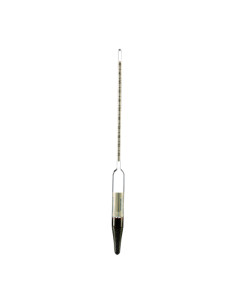
Bouyoucos hydrometers are laboratory instruments used for particle-size analysis of soils by sedimentation methods. They allow measurements to be taken from a suspension of soil and water in order to determine the distribution of the particles that make up the sample.
This procedure is used to study the sand, silt and clay fractions present in the soil. As the particles settle, the concentration of solids remaining in suspension decreases, and the hydrometer makes it possible to take the necessary readings during the test.
The Bouyoucos models available from Pobel form part of our range of laboratory hydrometers, are calibrated at 20 °C, and are offered with different scales depending on the analytical method used.
A Bouyoucos hydrometer, also known as a Bouyoucos density meter, is a type of hydrometer designed to work with suspensions used in soil particle analysis.
The hydrometer method is based on the sedimentation of particles suspended in water. Particles of different sizes have different settling velocities, so the concentration of solids remaining in suspension changes as the test progresses.
The hydrometer makes it possible to measure these changes by taking readings at a given depth and at the times specified by the analytical procedure.
Bouyoucos hydrometers are used specifically for particle-size or granulometric analysis of soils. This analysis makes it possible to determine the proportion of the main mineral fractions in a sample.
Using the hydrometer method, the following fractions can be determined:
Sand.
Silt.
Clay.
USDA technical documentation describes the hydrometer method as a procedure for measuring the percentages of sand, silt and clay present in the inorganic fraction of soil.
The method is based on the rate at which particles settle in a suspension. Once the soil sample has been dispersed in water, the particles begin to settle progressively.
The settling velocity is related to particle size. For this reason, the density of the suspension at a given depth decreases as particles gradually leave the suspension.
The Bouyoucos hydrometer is placed in the cylinder containing the sample and provides a reading related to the amount of particles that remain suspended at that moment.
The procedure is based on the principles of sedimentation described by Stokes’ law, which relates the settling velocity of particles to their characteristics and to the properties of the medium in which they are settling.
Pobel offers two Bouyoucos hydrometer configurations corresponding to different measurement scales.
The available models are:
Graduation from -5 to 60 g/L: with a division of 0.5 g/L.
Graduation from 0.995 to 1.038 specific gravity: with a division of 0.001 units.
These two scales make it possible to select the instrument according to the analytical procedure and the type of reading required.
ASTM E100 covers glass hydrometers used in various ASTM methods. Pobel specifically states that its Bouyoucos hydrometers are manufactured in accordance with ASTM E-100, 151-H or 152-H.
Pobel Bouyoucos hydrometers are calibrated at 20 °C. Temperature is a relevant parameter in this type of measurement because it affects the properties of the suspension and must therefore be taken into account during the procedure.
USDA documentation for the hydrometer method also indicates that ASTM 152-H hydrometers are calibrated at 20 °C and establishes the need to apply the corresponding corrections when test conditions differ from the reference conditions.
For this reason, the established analytical procedure should always be followed during testing, taking into account both the temperature and the specific sample preparation conditions.
To carry out particle-size analysis using the hydrometer method, it is necessary to achieve adequate dispersion of the soil particles. If the particles remain aggregated, they may behave during sedimentation like larger particles and affect the result.
Reference technical procedures use a dispersing solution to promote separation of the particles before readings are taken. USDA documentation specifically identifies incomplete dispersion of clay particles as one of the main sources of error in this method.
Once the suspension has been prepared and homogenised, it is placed in the sedimentation cylinder and the corresponding readings are taken according to the times and conditions specified by the method being used.
The exact procedure must follow the analytical method being used, but the general principle consists of preparing a homogeneous soil suspension and taking readings as sedimentation takes place.
To carry out the test correctly, factors such as the following must be controlled:
Sample dispersion before sedimentation begins.
The container used to hold the suspension.
Temperature during measurement.
Reading times specified by the procedure.
The hydrometer scale used in the method.
These factors form part of the analytical procedure and must be kept under control in order to correctly interpret the readings obtained.
To select a Bouyoucos density meter or hydrometer, it is necessary to check which scale is required by the analytical method to be followed.
Pobel currently offers two options:
-5 to 60 g/L, 0.5 g/L division.
0.995 to 1.038 specific gravity, 0.001 division.
Both are designed for soil analysis and calibrated at 20 °C. Before selecting a reference, it is advisable to check the type of reading required by the laboratory procedure being used.
It is used for particle-size analysis of soils by sedimentation, allowing measurements to be taken in relation to the particles that remain suspended in the sample during the test.
The hydrometer method is used to determine the distribution of the main particle-size fractions in soil: sand, silt and clay.
The models supplied by Pobel are calibrated at 20 °C.
Pobel offers one model graduated from -5 to 60 g/L, with divisions of 0.5 g/L, and another from 0.995 to 1.038 specific gravity, with divisions of 0.001.
According to the manufacturer’s specifications, they are manufactured in accordance with ASTM E-100, 151-H or 152-H.
Explore the Bouyoucos hydrometers for soil analysis available from Pobel and select the graduation that corresponds to the procedure you need to carry out. If you are unsure which reference to use, contact the Pobel team and our team will help you select the appropriate instrument.
 Quick delivery
 High quality
 Safe payment